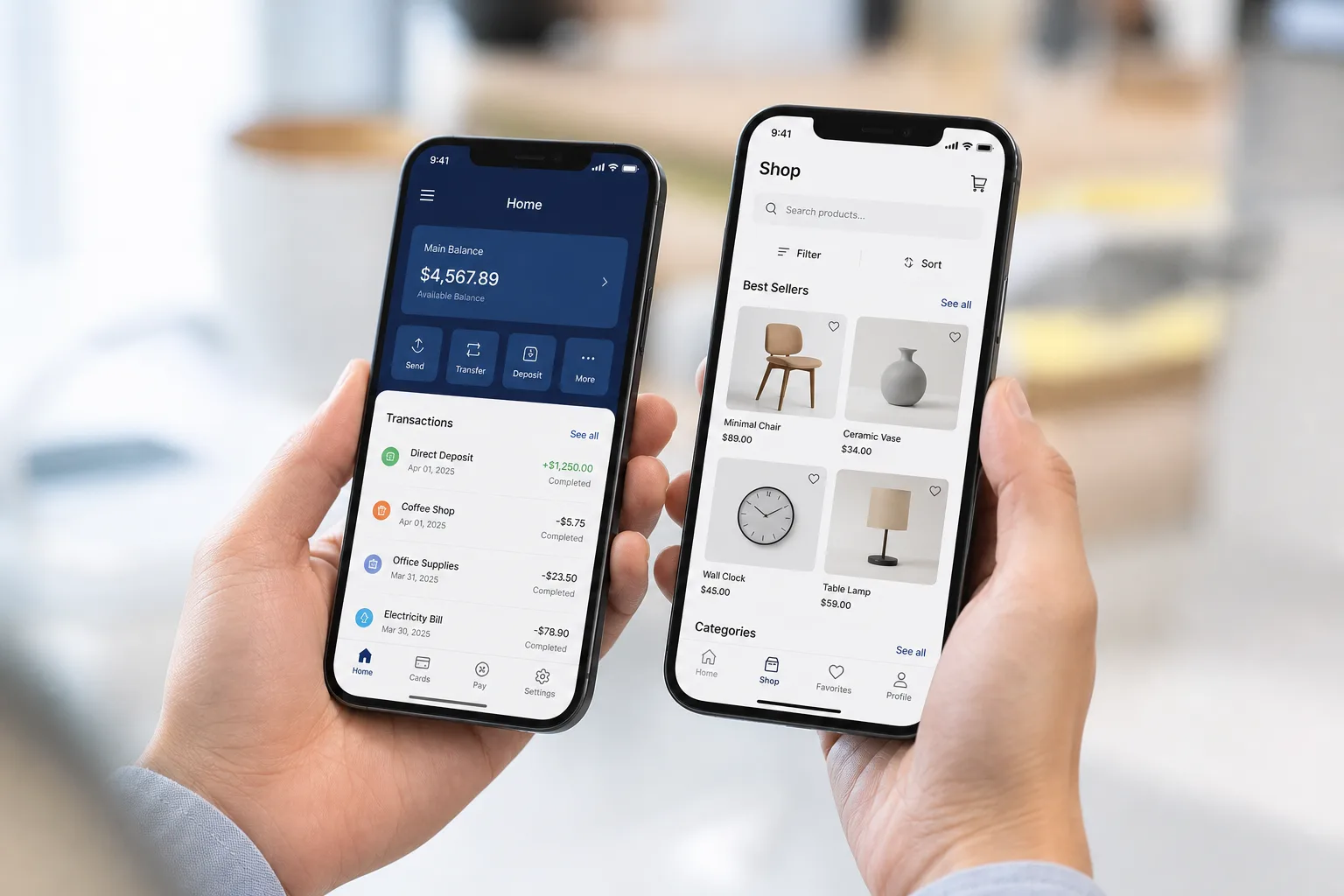
An app can look great on launch day. Clean design. Smooth animations. Then a user in Durban opens it on a budget Android phone with patchy 4G, and it freezes at checkout. That is the gap testing is supposed to close.
South Africa's fintech, retail, and delivery apps are growing fast. Banks, shops, and startups all need apps that work the same way for someone in Cape Town on fibre and someone in a small town on 3G. That is not a small ask.
This guide walks through what mobile app testing actually involves, how the QA process works step by step, what it costs, which tools QA teams rely on, and how to pick the right testing partner. Real industry examples are used throughout, not made-up numbers.
- Mobile app testing catches bugs, slow screens, security gaps, and UX issues before and after launch.
- South African QA must account for device fragmentation, patchy networks, expensive data, and POPIA security expectations.
- Typical testing budgets range from R10,000 to R40,000+, depending on complexity and compliance needs.
- The strongest results come from mixing manual testing, automation, security checks, and real-device testing.
- Start testing early, alongside development — not as a last-minute launch checklist.
What Is Mobile App Testing and Why Does It Matter in South Africa?
Mobile app testing is the process of checking an app before and after launch to catch bugs, slow screens, security gaps, and anything that breaks the user experience. Quality assurance, or QA, is the overall discipline behind that checking. It is not one step. It runs alongside development, not after it.
In South Africa, testing carries a few extra layers most other markets do not deal with in the same way. Android device usage is wildly mixed, from flagship phones to budget models running older software. Mobile networks swing between fast fibre-backed 4G and patchy rural coverage. Data is expensive for a lot of users, so a heavy, slow app gets uninstalled fast. And South Africans, especially banking customers, expect strong security by default.
Example 1: Banking Apps
Apps like Capitec Bank and FNB South Africa handle money, so testing has to go deep. That means secure login testing, transaction accuracy checks, and performance testing under load. A login screen that takes eight seconds to respond is not just annoying here, it is a trust problem.
Example 2: E-commerce Apps
Platforms like Takealot depend on checkout working every single time. That means checkout testing, payment gateway testing, and load testing during sales events like Black Friday, when traffic spikes hard and fast.
A reliable mobile app testing company in South Africa usually builds test plans around these exact local pressures instead of using a generic checklist.
Why Businesses in South Africa Need Mobile App Testing
Mobile app testing helps South African businesses deliver secure, reliable, and user-friendly apps while reducing errors and improving customer trust.
Growing Mobile App Market in South Africa
More South Africans are shopping, banking, and paying through apps than ever before. Mobile-first users, especially younger ones, often skip desktop entirely. Digital payments are growing across cities big and small, and app quality is now tied directly to whether a business keeps customers or loses them to a competitor's app.
Businesses building or scaling their digital footprint often start with a broader look at how mobile app development in South Africa actually works before testing enters the picture, since QA planning usually begins right at the development stage, not after.
Preventing Poor User Experience
Here is what goes wrong without proper testing: apps crash mid-session, screens load slowly, logins fail, and payments error out. Each of those problems chips away at trust. And the fallout is predictable. Negative app store reviews pile up. Customers leave. Retention drops. One bad experience is often enough for a user to delete an app and never come back.
Ensuring Security and Data Protection
This one matters a lot in South Africa. POPIA, the Protection of Personal Information Act, sets rules around how businesses handle customer data. Apps that store personal details, banking info, or health records need to meet those expectations. Secure authentication, encrypted storage, and careful handling of user data are not optional extras. They are baseline requirements for any serious app.
Types of Mobile App Testing in South Africa
Different problems need different testing approaches. Here is a quick breakdown:
| Testing Type | Purpose | Example |
|---|---|---|
| Functional Testing | Checks that features work as intended | Login, payment, search |
| Performance Testing | Checks speed under real conditions | High traffic during sales |
| Security Testing | Protects user data and transactions | Banking apps, fintech apps |
| Compatibility Testing | Confirms the app works across devices | Android and iOS variations |
| Usability Testing | Checks how easy the app is to use | Navigation, onboarding flow |
| Automation Testing | Runs repeated checks faster | Regression after each update |
Most serious apps need a mix of these, not just one. A banking app, for example, cannot skip security testing just because functional testing passed. Teams that plan app screens and flows often work from a mobile app design guide built for South Africa, since good design decisions early on make usability testing far easier later.
Mobile App Testing Process: How QA Works Step by Step
This is the part most business owners actually want to understand. Not the theory, the real workflow. Here is how QA usually plays out from start to finish, with a practical example at each stage.
Step 1: Requirement Analysis
Before any testing starts, the QA team needs to understand the app itself. What is it for? Who will use it? Which devices and operating systems matter most? What does the business actually need this app to achieve?
Example: For a grocery delivery app targeting Johannesburg and Pretoria, the QA team would need to know delivery radius logic, peak order times, and which payment methods customers use most. Testing a delivery app without knowing its busiest hours is like testing a highway without checking rush hour traffic.
Step 2: Test Planning
Once requirements are clear, the team builds a test plan. This covers scope (what gets tested and what does not), a timeline, the tools that will be used, and who is responsible for each part.
Example: A fintech startup launching a lending app might scope its first test cycle around loan application flow and identity verification, leaving less critical features like referral programs for a later round. Trying to test everything at once usually just slows the whole release down.
Step 3: Test Execution
This is where the actual checking happens, combining manual testing and automated testing. Manual testers click through the app like a real user would, paying attention to feel and flow. Automated scripts handle repetitive checks, like confirming login still works after every small code change.
Example: A retail app team might manually test a new checkout redesign for usability, while automation scripts run in the background confirming the payment API still returns correct responses across a hundred test transactions.
Step 4: Bug Reporting and Fix Validation
Every issue found gets logged, described clearly, and handed to developers. Once fixed, testers go back and confirm the fix actually worked and did not break something else nearby. Tools like Jira, TestRail, and BrowserStack are commonly used to track and manage this back and forth.
Example: A tester finds that OTP codes for a banking app take too long to arrive on certain networks. That bug gets logged with device details and network conditions attached, developers adjust the SMS gateway settings, and testers re-check it across multiple carriers before marking it resolved.
Step 5: Final Testing and App Release
Before an app goes live, it gets one more full pass. App Store and Google Play submission requirements get checked, since both platforms reject apps for different technical reasons. After launch, production monitoring continues, watching for crashes or slowdowns that only show up once real users are on board.
Example: A ride-hailing app might run a final round of GPS accuracy tests across different Android models right before submission, since location bugs are far easier to catch before launch than after thousands of users download it.
Manual vs Automation Mobile App Testing: Which Is Better?
Neither one wins outright. They solve different problems.
| Manual Testing | Automation Testing |
|---|---|
| Done by a human tester | Run through pre-written scripts |
| Good for judging usability and feel | Good for repeating the same checks often |
| Lower cost to start | Higher setup cost upfront |
Manual testing catches things scripts miss, like an awkward button placement or a confusing flow. Automation shines when the same test needs to run hundreds of times, like confirming login still works after every update.
Many South African startups begin with manual testing since it costs less to start, then shift toward automation as the app grows and updates happen more often.
Teams comparing app development companies across South Africa often find that the ones offering solid QA support already have this balance figured out, rather than treating testing as an afterthought.
How Much Does Mobile App Testing Cost in South Africa?
There is no single fixed price here, and honestly, anyone quoting an exact number without knowing your app is guessing. Costs vary depending on project requirements. A small app might only need basic functional testing. A banking or enterprise app usually needs security testing, performance testing, and automation layered together, which raises the price accordingly.
| Testing Level | What It Covers | Estimated Cost (ZAR) |
|---|---|---|
| Basic Functional Testing | Checks core features on a simple app | R10,000 – R15,000 |
| Standard QA Testing | Adds device checks and basic usability testing | R15,000 – R25,000 |
| Advanced Testing | Adds security, performance, and load testing | R25,000 – R35,000 |
| Enterprise / Banking-Grade Testing | Full security, automation, and compliance testing | R35,000 – R40,000+ |
Testing budgets are generally shaped by hourly QA rates, project-based packages, or the cost of a dedicated QA team working alongside development. Businesses already tracking their mobile app development cost in South Africa should budget testing as a separate line item, not something squeezed out of what is left over.
Best Mobile App Testing Tools Used by QA Teams
Explore the top mobile app testing tools QA teams use to improve app quality, automate testing, and deliver reliable user experiences.
- Appium: automates testing across both Android and iOS from one script base
- Selenium: widely used for web and hybrid app testing automation
- BrowserStack: lets teams test on real devices in the cloud without owning every phone model
- TestRail: organizes test cases and tracks results across a team
- Jira: manages bug reports and links them to development sprints
- Firebase Test Lab: runs automated tests across a wide range of real and virtual Android devices
Ongoing tool costs and monitoring setups tend to overlap with what businesses already spend on mobile app maintenance support in South Africa, since testing tools and monitoring tools often work side by side after launch.
Mobile App Testing Challenges in South Africa
Understand the common mobile app testing challenges South African businesses face and how to overcome them for better app performance and reliability.
Device Fragmentation
South Africa's Android market runs across a huge range of manufacturers and price points, from high-end Samsung Galaxy devices to budget phones that barely meet minimum specs. An app that runs perfectly on a flagship phone can lag badly on an older, lower-spec device. Testing across a real spread of devices is the only way to catch this early.
Network Performance Issues
Testing on WiFi alone is not enough. Real users bounce between WiFi, 4G, and in some areas, still rely on slower connections. An app needs to be tested under low-connectivity conditions too, since that is where checkout failures and login timeouts usually show up first.
Security Expectations
Fintech, banking, and healthcare apps carry the highest security bar. Users trust these apps with sensitive information, and one data breach can undo years of brand trust in a single news cycle.
Best Practices for Mobile App Testing in South Africa
Follow proven mobile app testing best practices to improve app quality, enhance user experience, and reduce costly issues before launch.
- Start testing early, alongside development, not after it is finished
- Prioritize security testing, especially for apps handling money or personal data
- Test on real devices, not just simulators
- Automate repetitive checks to save time on future updates
- Monitor the app closely after launch, not just before it
- Test scenarios that reflect actual South African user behavior, like patchy networks and mixed devices
Common Mistake: Many startups only test once the app feels "ready" for launch. This usually backfires, because big issues surface too late to fix without delaying the release. Testing works better woven into every stage, not bolted on at the end.
Businesses that plan for the long run often pair testing with ongoing mobile app maintenance services in South Africa, since an app's quality does not stop mattering the day it launches.
How to Choose a Mobile App Testing Company in South Africa
Learn what to look for when choosing a mobile app testing company in South Africa, from QA expertise and tools to industry experience and support.
Check Industry Experience
Look for a team that has handled apps in your specific space, whether that is fintech, retail, healthcare, or logistics. Testing a banking app and testing a food delivery app require very different priorities.
Review Testing Approach
A strong QA partner combines manual and automated testing, takes security seriously, and gives clear, readable bug reports, not vague notes that leave developers guessing.
Evaluate Communication
If testing is outsourced, communication becomes everything. Delays in reporting or unclear updates slow the whole release cycle down. A team should keep you informed at every stage, without you needing to chase updates constantly.
Some businesses looking to combine app building and QA under one roof choose a full-service mobile app development company in South Africa that handles testing as part of the build, rather than juggling separate vendors for each piece.
Real-World Mobile App Testing Examples in South Africa
These are used here as general industry examples, not claims about any specific company's internal testing process.
Banking App Example
Apps from Capitec, FNB, and Standard Bank all rely on strict testing around transactions, login security, and app performance during peak banking hours, like month-end.
Retail App Example
Takealot-style retail apps depend on product search accuracy, smooth checkout, and payment reliability, especially during major sales periods when traffic multiplies overnight.
Transport App Example
Ride-hailing apps like Uber South Africa lean heavily on GPS accuracy, a smooth booking flow, and dependable in-app payment processing, since even a small location glitch can send a driver to the wrong street.
Future of Mobile App Testing in South Africa
AI-powered testing tools are starting to predict where bugs are likely to appear, instead of waiting for testers to stumble on them. Automation is growing across more industries, not just tech-heavy ones. Security testing keeps gaining weight as data protection rules tighten. And cloud testing platforms are making it easier for South African teams to test across dozens of real devices without owning a single one of them physically.
Conclusion
Mobile app testing is no longer something businesses can treat as optional. From banking and e-commerce to healthcare and logistics, apps that reach South African users need proper QA behind them to feel secure, fast, and dependable.
Mixing manual testing, automation, security checks, and real-device testing gives businesses a much stronger shot at getting it right the first time.
Picking the right testing approach and the right partner is what separates a shaky launch from a confident one.
Frequently Asked Questions
1. What is mobile app testing?
It's the process of checking an app for bugs, crashes, slow speed, and security gaps before and after it goes live.
2. Why is app testing important for South African businesses?
It prevents crashes, payment errors, and security issues, which protects customer trust and app store ratings.
3. How long does mobile app testing usually take?
It depends on app size, but most projects run testing in cycles alongside development, not as one final step.
4. Does mobile app testing cost a lot in South Africa?
Costs vary by app complexity, platforms, and testing type. Simple apps cost less; banking or enterprise apps cost more.
5. What is the difference between manual and automated testing?
Manual testing uses human testers for usability checks. Automated testing uses scripts for fast, repeated checks.
6. Do small business apps need security testing?
Yes, especially if the app stores personal data or handles payments. POPIA compliance matters even for small apps.
7. Which devices should be tested for a South African audience?
A mix of budget and premium Android phones, plus iPhones, since the local market is highly varied.
8. Can testing happen after an app is already launched?
Yes, through production monitoring, but catching issues before launch is cheaper and safer than fixing them after.