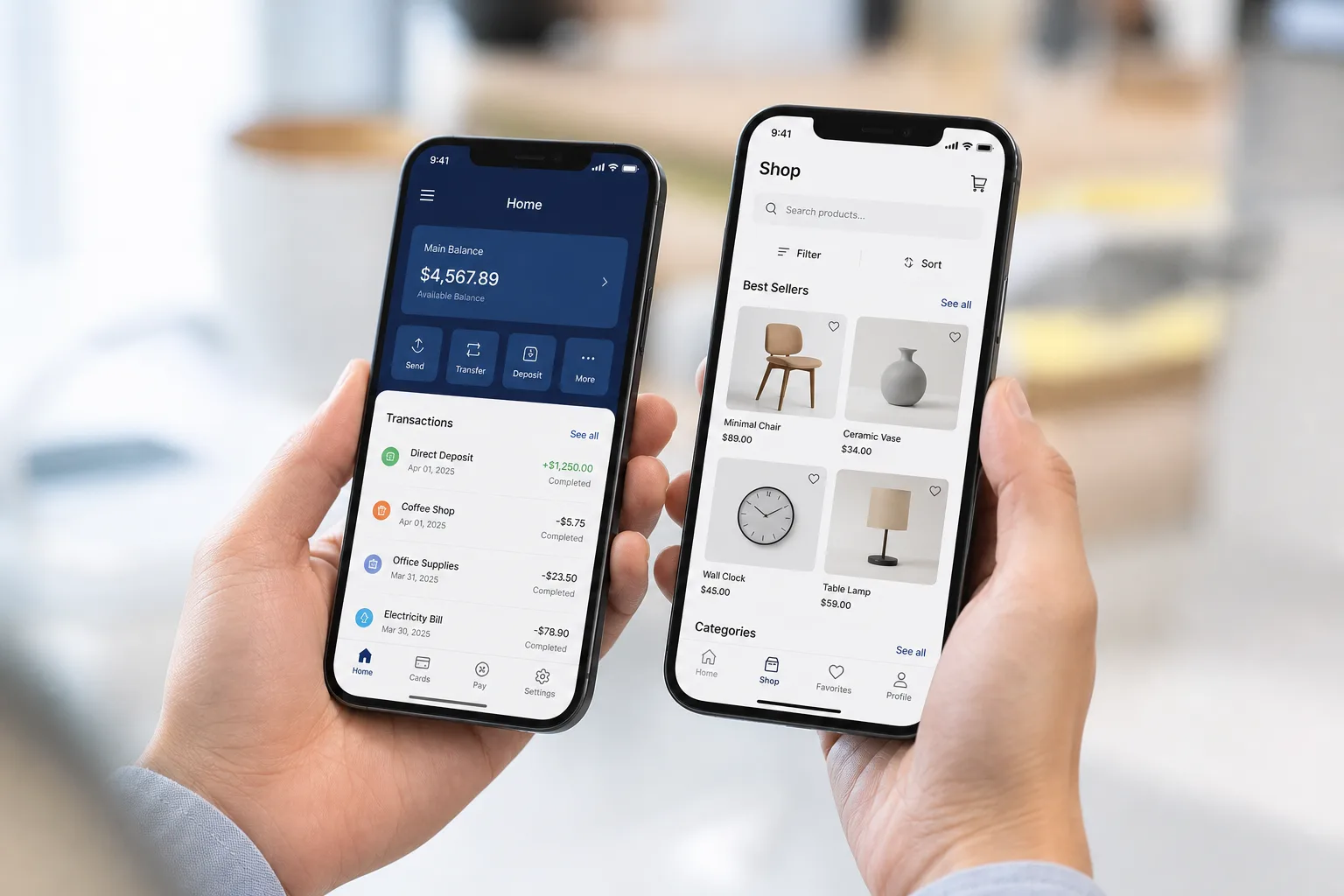
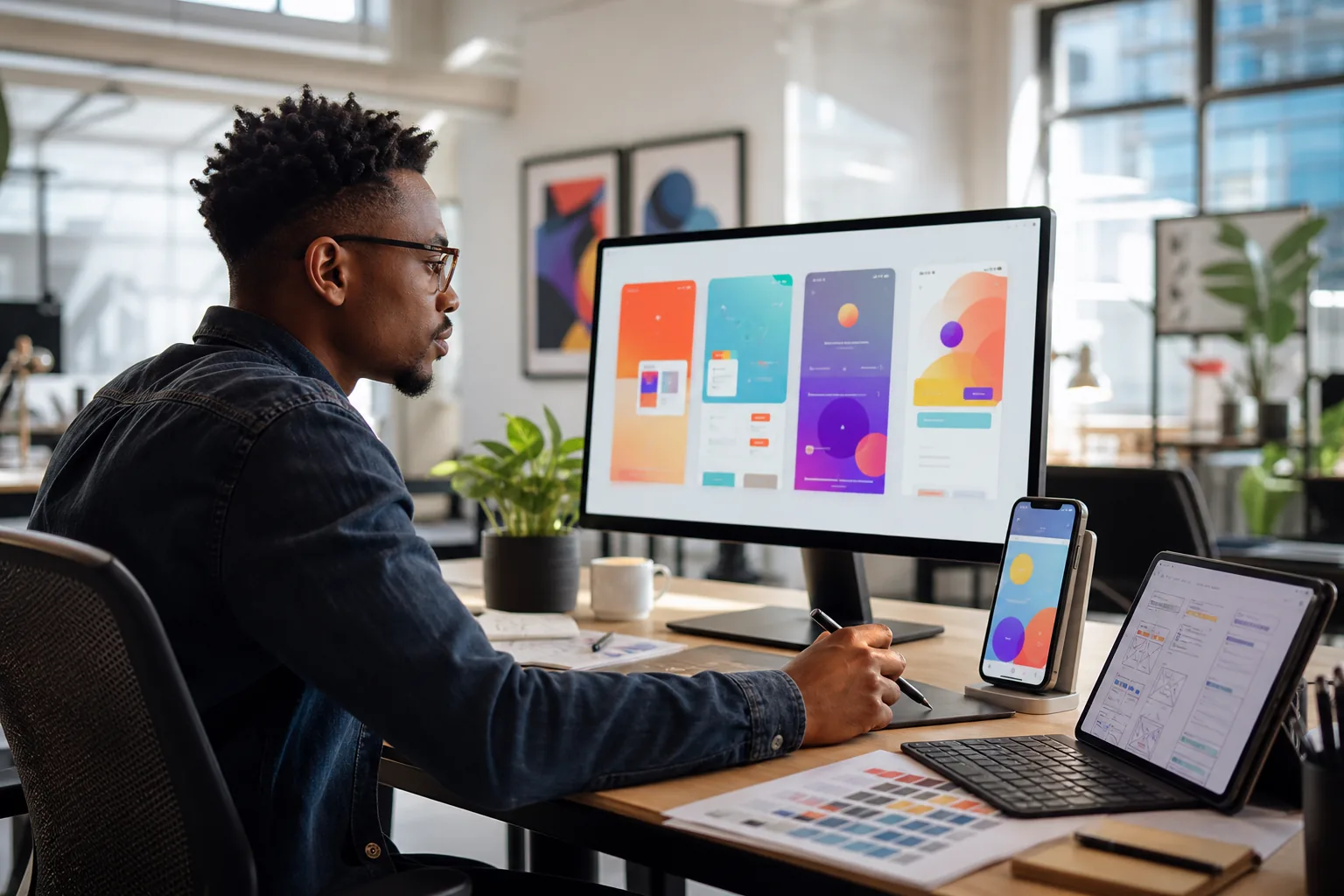
Mobile app design services in South Africa are booming, and there's a solid reason why. Smartphone use keeps climbing, and businesses across Johannesburg, Cape Town, and Durban are racing to build apps that actually work, not just look nice.
The global app design and development market was valued at $3,950 million in 2025, with fast growth expected through 2033. That momentum is landing in South Africa too, where digital adoption keeps rising among younger users.
This guide breaks down real costs, the full design process, and how to pick a design partner you can trust.
- Mobile app design in South Africa typically costs between R50,000 and R1,500,000+, depending on project complexity.
- User research and wireframing reduce costly design changes before development begins.
- Strong UX design improves user retention, conversions, and long-term business growth.
- Compare agencies based on process, expertise, communication, and post-launch support, not just pricing.
- Investing in professional app design creates better user experiences and higher returns over time.
What Are Mobile App Design Services?
Most businesses want to jump straight into polished screens because that feels like progress. Experienced design teams do something different. They spend real time validating structure and flow first, because a navigation problem caught early is cheap to fix, and the same problem caught after development starts is not.
Mobile app design services cover everything that happens before a single line of code gets written. UI design is what the app looks like: colors, buttons, fonts, icons. UX design is how the app feels to use. Can someone find the checkout button in two taps or five? Does the app remember where they left off if a call interrupts them?
A full design service usually includes user research, wireframing, prototyping, design systems, and UX strategy — the same building blocks behind our professional mobile app design services and tailored software solutions built for South African brands.
Key Takeaway: A visually attractive interface may get someone to open an app. A well-planned experience is what gets them to keep using it. That difference sets up everything else in this guide, starting with why South African businesses can't afford to skip it.
Why South African Businesses Need Professional Mobile App Design Services
Users judge an app in seconds. If the first screen feels confusing, most people close it and never come back. Research shows 88% of online users are less likely to return to an app after a poor experience, and that number holds true whether the user is in Cape Town or Chicago. It's also why demand for enhanced user experience is one of the strongest drivers behind the entire app design and development market right now.
Imagine a grocery delivery startup launching in Johannesburg. The founders might believe product variety is their biggest advantage. During usability testing, they usually discover something else entirely: customers abandon their cart because checkout takes too many steps. Simplifying that one journey often creates more business impact than adding another hundred products ever would.
This isn't just a local trend. The Middle East and Africa region, which includes South Africa, is growing at close to 19.5% a year in this market. Part of that momentum comes from businesses prioritizing digital transformation: global IT spending on enterprise software, a key part of that shift, is expected to grow by 13.7% in 2024 alone. Better mobile connectivity, government digitalization programs, and a young population that expects to do everything on a phone are all pushing this growth further.
Expert Insight: One mistake businesses frequently make is treating design as a visual activity instead of a product strategy exercise. In most successful South African app launches, the biggest decisions get made before a single screen exists.
Key Takeaway: Good design isn't about decoration. It's what decides whether users trust an app enough to keep coming back. That trust gets built during the design process, which is exactly what the next section walks through.
Mobile App Design Process in South Africa (Step-by-Step)
Most design agencies in South Africa, whether based in Johannesburg, Durban, or Pretoria, follow an end-to-end mobile app development process built around one goal: catching problems while they're still cheap to fix.
Step 1: Requirement Analysis and User Research
Designers study business goals, target audience, and competitors. For a local retail app, that often means researching how South African shoppers behave on mobile versus desktop, since the two rarely look the same. This research becomes the foundation for the next step, where those findings turn into an actual screen structure.
Step 2: Information Architecture
Someone needs to map how the app is structured before any visuals happen. What screens exist? How does a user move between them? Get this wrong, and users spend more time getting lost than getting things done.
Step 3: Wireframing
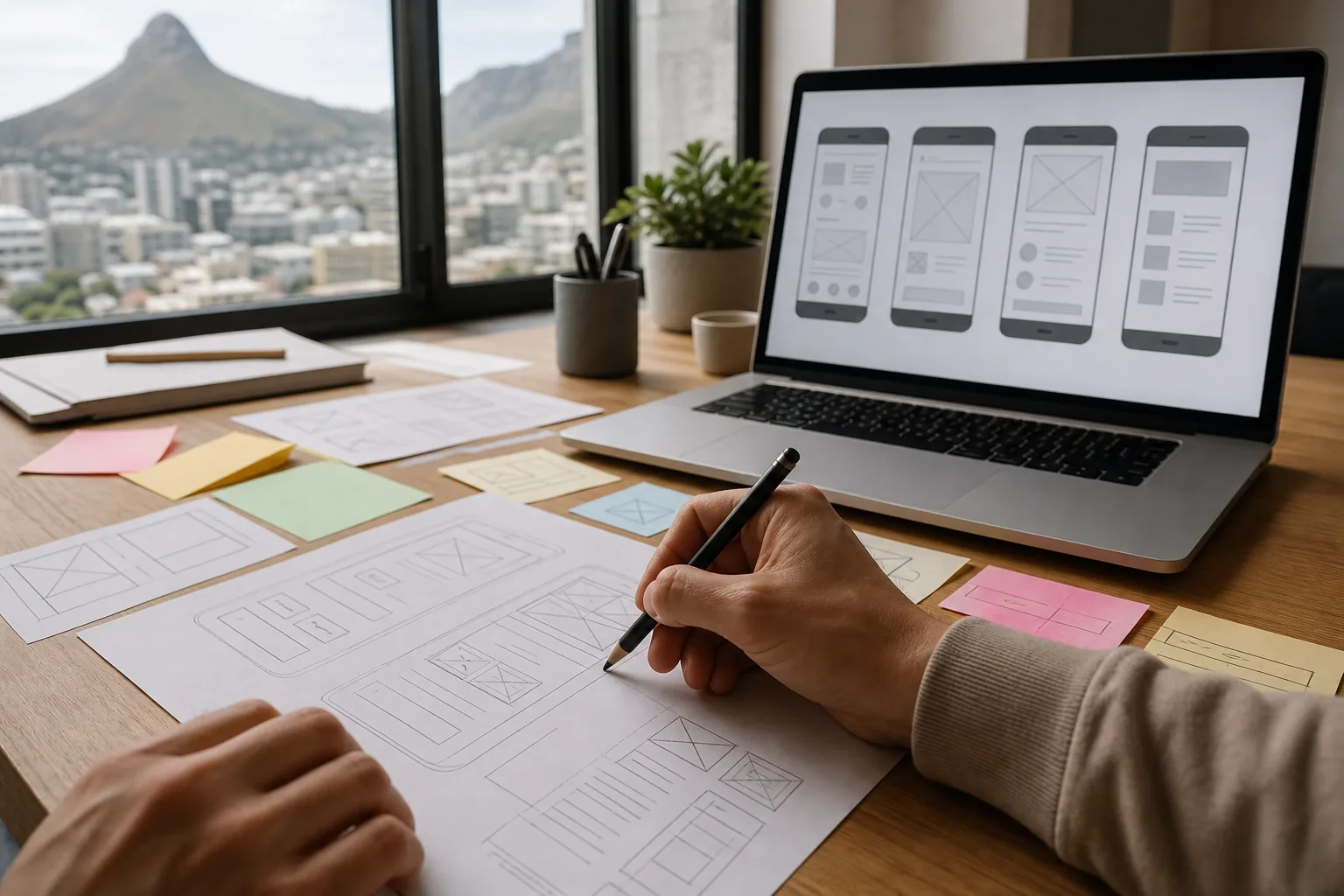
Wireframes are rough sketches — no color, just boxes and labels. This step is cheap to change, which matters, because catching a bad layout here costs far less than fixing it once development has already started.
Step 4: UI Design
Now the visual layer comes in: color palette, typography, buttons, spacing. This is where the app starts to look like something people would actually want to use.
Step 5: Interactive Prototype
A clickable prototype lets real users test the flow before any code exists. Can you design first and develop later? Yes, and this step is exactly why. Feedback gets collected here, while changes are still fast and inexpensive.
Step 6: Design Handoff to Developers
Once designs are locked in, the team hands off specs, assets, and files to development. This is where our end-to-end mobile app development process really pays off, since solid handoff documentation saves weeks of back and forth later.
Step 7: Testing and Design Optimization
Design doesn't stop at launch. Usability testing and A/B testing continue, and small tweaks keep improving the experience over time.
Expert Insight: One pattern shows up across almost every app project. Businesses underestimate how long it takes to validate user journeys properly. Once development starts, even a small navigation change tends to affect multiple screens, which pushes both timeline and budget up.
Key Takeaway: Every step in this process exists to catch expensive mistakes early. That directly shapes what a project costs, which is exactly where a lot of businesses have the most questions.
How Much Does Mobile App Design Cost in South Africa?
Design costs in South Africa generally fall between R50,000 and R1,500,000+, and the reason the range is so wide comes down to complexity, screen count, and how much research gets built in. Here's a detailed mobile app development cost breakdown to help you plan.
| App Type | Estimated Design Cost | What's Typically Included |
|---|---|---|
| Basic App Design | R50,000 – R70,000 | Simple wireframes, standard UI, limited screens |
| Medium Complexity App | R70,000 – R120,000 | Custom UI, user research, interactive prototype |
| Complex Enterprise App | R120,000 – R150,000+ | Full research, custom design system, extensive testing |
Who should choose which range?
A basic package usually fits a startup testing an idea with a small user base. Medium complexity fits most SMEs building a real product for paying customers. Enterprise-level design fits businesses with multiple user types, integrations, or strict compliance needs, like fintech or healthcare.
Picture a Durban-based fintech startup building its first customer app. The founders originally wanted a long, detailed onboarding flow to collect as much user data as possible upfront. User testing told a different story. Breaking registration into smaller steps raised completion rates noticeably, because users trust an app more when it doesn't ask for everything on day one.
Hidden Costs to Watch For
Revisions beyond the agreed scope, extra screens added mid-project, and rushed timelines all push the price up. Ask upfront how many revision rounds are included before signing anything.
Ways to Reduce Mobile App Design Cost
Start with a clear, written scope. Reuse proven UI patterns instead of custom animations where they aren't necessary. Combine research and testing into the same phase instead of running them separately.
Cost versus ROI
Globally, a sophisticated app project often runs past $250,000 once design and development are combined, especially as more of that budget goes toward cloud backend infrastructure — global cloud infrastructure spending surpassed $290 billion in 2023 alone. South African pricing sits well below these international benchmarks for comparable quality. Is expensive design actually worth it? For most growing businesses, yes, because losing users to a confusing app costs more in the long run than the design investment itself.
Expert Insight: Businesses that only compare price tags tend to miss the real question, which isn't "what does this cost" but "what does a bad app cost me in lost customers." That reframing changes almost every buying decision.
Key Takeaway: Cost depends less on the agency's day rate and more on how much complexity, research, and revision your app actually needs. That leads directly into the specific factors that move the number up or down.
Factors That Influence Mobile App Design Cost in South Africa
Platform selection
Designing for iOS, Android, or both changes the scope. Cross-platform design can save money, though it sometimes means giving up a bit of that native feel.
Design complexity
Standard UI patterns cost less than custom interfaces built around advanced animations and interactions.
Industry requirements
A healthcare app has to think carefully about privacy in its design, since 71% of consumers say they're concerned about how their data gets handled. A fintech app needs to build trust into every screen, because users are handing over money and personal details.
Designer experience
A freelancer, a design agency, and a specialized in-house team all come with different price points. This matters more than usual right now: the global technology talent shortage is estimated to exceed 40 million workers by 2030, and that shortage tends to push rates up for experienced designers.
Timeline
Need it fast? Rushed timelines usually pull in extra resources, and that costs more.
Key Takeaway: These five factors explain almost every price difference between two quotes for the same app idea. Once complexity and industry are settled, the next question becomes what you're actually paying for.
Key Features Included in Professional Mobile App Design Services
A solid design package usually covers user research, UX strategy, wireframes, UI mockups, a design system, an interactive prototype, usability testing, and developer support during handoff — the core of any set of tailored software solutions built for growing businesses.
If an agency skips most of these and jumps straight to polished screens, that's worth asking about directly. While custom animations often get attention during planning, they rarely solve usability problems on their own. For most business apps, clear navigation and intuitive flow create more long-term value than decorative visuals ever will.
Mobile App Design Trends in South Africa (2026)
AI-powered personalization is becoming more common, with apps adapting to each user's behavior rather than showing everyone the same layout. Voice-based interfaces matter for accessibility, especially for users who'd rather speak than type. Dark mode isn't optional anymore; users expect it. Minimal interface design keeps navigation fast by cutting unnecessary taps.
Localized experiences matter most here. An app built for Cape Town shoppers might need different payment options than one built for a rural user base working with slower connections. With smartphone use worldwide expected to pass 7.5 billion users by 2026, the businesses winning locally are the ones designing for how South Africans actually use their phones, not a generic global template.
How to Choose the Right Mobile App Design Company in South Africa
This is where businesses either save money long-term or end up paying twice.
Check the portfolio for experience in your specific industry. A team that's designed healthcare apps understands compliance concerns a general design shop might miss entirely. Review their UX process, not just their visuals; ask how they approach research, wireframing, and testing. Evaluate communication early. A partner who goes quiet for three weeks during a project is a warning sign, not a coincidence. Understand the pricing model, whether fixed price or hourly, before work begins. Check what post-design support looks like once developers take over. These are the same standards that separate the best app developers in SA from the rest.
Expert Insight: The right design partner should walk you through every stage of the process, involve you in reviews, and validate user flows before development ever starts. If a company can't explain their process clearly, that's usually a sign the process doesn't exist.
Mobile App Design Cost Comparison: Freelancer vs Agency vs In-House Team
| Option | Cost | Best For |
|---|---|---|
| Freelancer | Low | Small apps, tight budgets |
| Design Agency | Medium-High | Business apps needing a full process |
| In-house Team | High | Large companies with ongoing app needs |
A freelancer can work well for a simple app on a small budget. An agency usually makes more sense once a project needs proper research, testing, and a full team behind it. In-house teams fit companies planning to build and update apps continuously, not just once.
Common Mistakes Businesses Make While Designing Mobile Apps
- Starting design without user research
- Copying a competitor's app instead of solving your own users' actual problems
- Skipping usability testing to save a few weeks
- Focusing only on how things look instead of how they work
- Designing for today without leaving room for growth
Does redesign increase cost? Almost always, and by more than people expect. One common challenge teams run into is designing for the app they have right now, without planning for what it might need in a year. Fixing that later usually means an expensive rebuild, not a quick patch.
Why Invest in Professional Mobile App Design Services?
Good design isn't a cost line. It's what drives higher retention, better conversion, stronger brand perception, fewer expensive changes during development, and faster adoption after launch.
If budget only stretches far enough for one investment, prioritizing user research over visual polish usually produces the stronger long-term return, since it solves usability problems before development locks them in. In real South African app projects, businesses that plan UX early consistently spend less fixing problems after launch than those that don't.
Final Thoughts
Mobile app design services in South Africa aren't a nice-to-have anymore. They're what decides whether an app gets used or gets deleted. With the Middle East and Africa region growing at close to 19.5% a year, more South African businesses are putting real budget behind design, not just development.
The smartest move is treating design as a business decision, not a cosmetic one. Pick a partner who explains their process, backs it with research, and tells you the truth about cost. That choice, more than any single feature, usually decides whether your app actually grows your business.
Frequently Asked Questions
How much does mobile app design cost in South Africa?
Usually R50,000 to R1,500,000+, depending on app complexity, screen count, and how much research and testing is included.
How long does mobile app design take?
Most basic apps take four to eight weeks. Complex apps with deep research and testing can take three months or longer.
Is expensive design actually worth the investment?
Yes, in most cases. Poor design drives users away fast, and 88% of people won't return to an app after one bad experience.
Can I skip UX research to save money early on?
You can, but it usually costs more later, since fixing usability problems after launch costs far more than fixing them in design.
Should I hire a freelancer or a full design agency?
Freelancers suit small, simple apps on tight budgets. Agencies fit larger projects needing full research, testing, and support.
What is the real difference between UI and UX design?
UI is what the app looks like. UX is how it works and feels when someone actually uses it every day.
Does a mid-project redesign really increase the cost?
Yes, almost always. Changing navigation or flow after development starts affects multiple screens and adds real time and budget.
How many screens are usually included in a design package?
It varies by package, but most basic apps include ten to twenty core screens as a starting point.