
Got a Shopify quote that made your jaw drop? You are not alone.
Many owners overpay. Others pay too little and rebuild later. Both hurt.
Here is the short answer. Shopify store development costs in South Africa run from ZAR 30K to ZAR 350K+. Design, apps, payments, and shipping move the price.
This guide covers what the price includes, hidden costs, sample budgets, smart savings, and how to pick a developer.
- Most Shopify store builds in South Africa fall between ZAR 30K and ZAR 350K+, depending on design and integrations.
- The development fee is separate from your Shopify subscription, apps, and payment processing.
- Local gateways such as PayFast and Yoco replace unavailable Shopify Payments.
- Monthly running costs include apps, maintenance, marketing, and transaction fees.
- A lean launch and phased features help you control spend without cutting corners.

What Are the Benefits of Shopify Store Development?
Shopify store development helps South African businesses launch online, manage sales, and grow without building an ecommerce platform from scratch.
Easy Store Management
Manage products, orders, inventory, and customer details through Shopify Admin.
Mobile-Friendly Shopping
Give customers a smooth shopping experience across smartphones, tablets, and desktops.
Secure Payment Integration
Connect supported payment gateways like PayFast to accept online payments in South Africa.
Flexible Store Customisation
Use Shopify themes, apps, and Liquid customisation to match your brand and business needs.
SEO and Marketing Tools
Optimise product pages, meta descriptions, and URLs to improve search visibility and attract shoppers.
Scalable Ecommerce Platform
Add products, sales channels, integrations, and automation as your business grows. Working with a Shopify development company in South Africa helps you plan that growth from day one.
How Much Does Shopify Store Development Cost in South Africa?
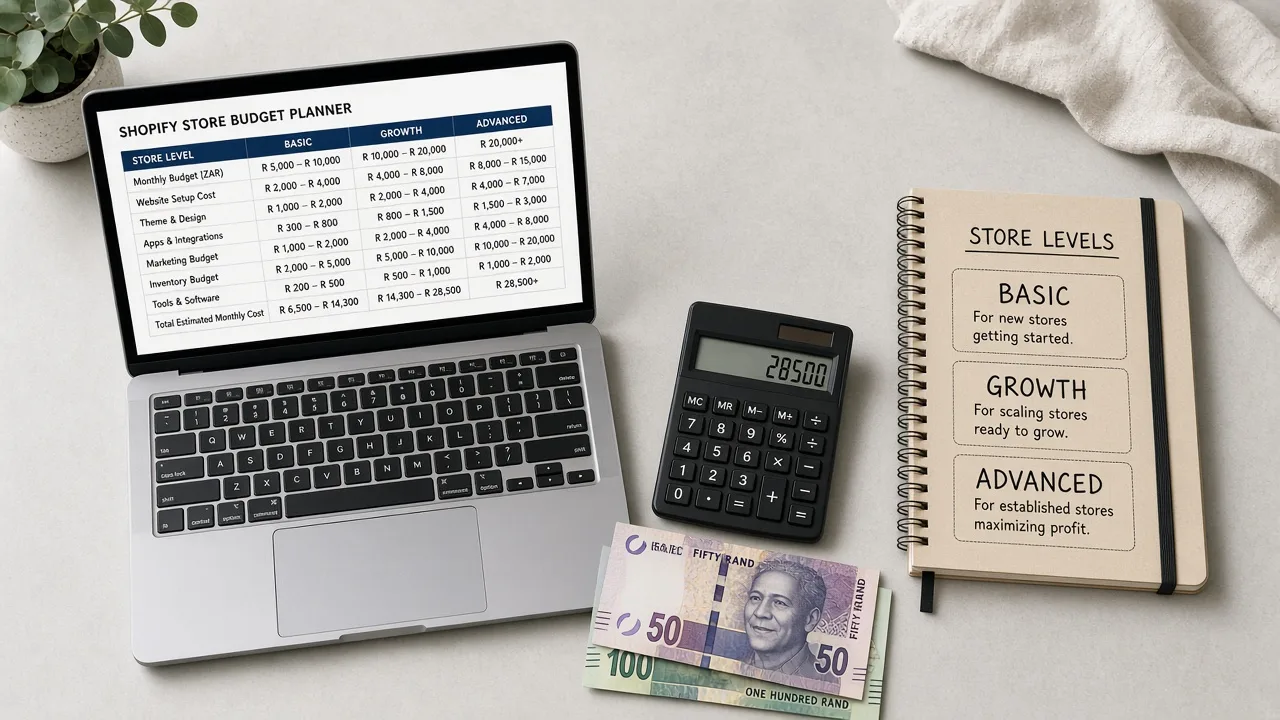
Most stores land between ZAR 30K and ZAR 350K+. The table below shows cost, timeline, and features for each build level.
| Store level | Cost | Timeline | Main features |
|---|---|---|---|
| Basic Shopify Store | ZAR 30K to 80K | 3 to 6 weeks | Premium or free theme, light branding, up to 100 products, PayFast or Yoco, basic shipping rates |
| Advanced Shopify Business Store | ZAR 80K to 180K | 6 to 12 weeks | Custom design, Liquid edits, app setup, courier tools, SEO setup, email flows |
| Enterprise Shopify Solution | ZAR 180K to 350K+ | 12 to 24 weeks | Shopify Plus, ERP links, multi-currency, custom checkout, migration, advanced reporting |
Basic Shopify store: R30,000–R80,000
This package may include a premium theme, basic branding, essential store pages, product uploads, payment setup, shipping rules, and mobile testing.
It suits a business that wants a professional store without extensive custom development. The scope should state how many products, pages, and revisions are included.
Growth Shopify store: R80,000–R180,000
A growing store may need a more tailored design, custom theme sections, advanced product filters, email marketing connections, courier integrations, and better reporting.
The extra cost comes from the work required to connect these parts and test them together. A long list of apps is not automatically better. Each one should solve a clear business problem.
Advanced Shopify store: R180,000–R350,000+
This budget may cover complex catalogue structures, system integrations, large product migrations, advanced automation, multi-market setup, or specialist development.
Shopify Plus may be worth considering for some larger businesses, but it is not a requirement for every store in this price range. Its subscription is separate from the development fee.
What Does Shopify Store Setup Cost Actually Include?
A quote is a bundle of tasks. Knowing each task helps you compare offers and spot gaps.
Many agencies offering Shopify development services in South Africa list these steps. Some hide them inside one big number.
Store planning and requirements
Planning is the scoping phase. Your developer maps products, pages, customer journeys, and goals. A clear brief stops scope creep. It also protects your timeline and your wallet.
Theme selection and setup
The theme is your storefront base. Shopify Theme Store options are fast and mobile-ready. Setup covers fonts, colours, and layout. A good pick saves weeks of custom work.
UI/UX and visual customisation
UI and UX shape how shoppers feel and move. Good design lifts conversion rate optimisation. Developers adjust spacing, buttons, and mobile views. Small tweaks often bring big sales gains.
Product and collection setup
This step adds products, variants, prices, and images. Collections group them so shoppers find items fast. Clean catalogue structure also helps search engine optimisation. Messy data costs you sales.
Payment and shipping configuration
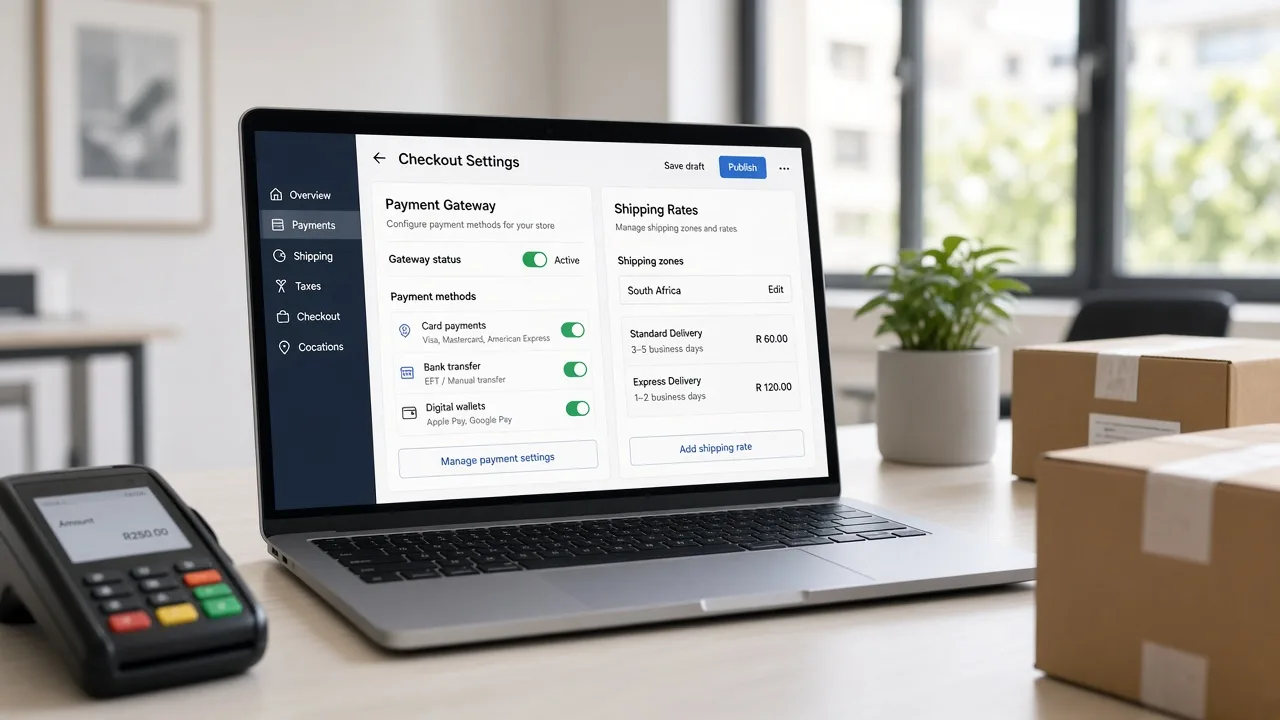
Shopify Payments is not available in South Africa. You need a local gateway such as PayFast or Yoco. Shipping needs rates, zones, and courier links. Wrong settings can eat your margin.
Essential pages and navigation
Every store needs Home, About, Contact, Shipping, Returns, and policy pages. Menus guide shoppers. Good navigation builds trust. Shoppers leave when they cannot find a returns page.
Apps and integrations
Apps add reviews, email tools, upsells, and subscriptions. Integrations link your store to accounting or stock tools. More apps mean more monthly fees. Pick only what earns its keep.
Testing, launch, and handover
Testing covers mobile views, checkout, browsers, and page speed. A tester places real orders. Handover gives you logins, guides, and backups. Never launch without a full checkout test.
Staff training, if included
Training shows your team how to add products, process orders, and run refunds. Many agencies skip it. A team that skips training can break their own store in week one. Training often costs far less than the fix.
Shopify Subscription Costs in South Africa
The development fee is a one-off project cost. Your Shopify subscription is a separate recurring expense.
Shopify lists its core plans in US dollars on its South African pricing page. The listed prices can change, and the amount charged in rand depends on the billing terms, exchange rate, and any applicable taxes or bank charges.
| Shopify plan | Listed annual-billing price per month | Listed monthly-billing price |
|---|---|---|
| Basic | US$19/month | US$25/month |
| Grow | US$49/month | US$65/month |
| Advanced | US$299/month | US$399/month |
| Shopify Plus | From US$2,300/month on the listed term | Check the current Plus offer |
You may also run a regular company site. Our guide on website development cost in South Africa shows how that price differs.
Shopify Theme, Design, and Customisation Costs
Your theme affects how your store looks and how shoppers use it. It also affects how much custom development you may need.
| Design option | Indicative budget | What to consider |
|---|---|---|
| Free theme with basic setup | R0 for the theme itself; setup is extra | Lower theme cost, but still needs configuration |
| Premium theme | Often a few thousand rand, depending on the theme | Check the current price and licence terms |
| Theme customisation | R8,000–R40,000+ | Cost depends on layout changes and custom sections |
| More extensive custom design and development | R40,000–R100,000+ | More design, coding, and testing work may be needed |
Monthly and Annual Shopify Store Running Costs
Launching your store is only the first expense. You also need a budget for keeping it online and running the business.
| Ongoing expense | Planning estimate | Notes |
|---|---|---|
| Shopify subscription | Depends on plan and billing | Check the current official price |
| Domain renewal | Often a few hundred rand per year | Depends on the domain and registrar |
| Paid apps | R0–R5,000+ per month | Depends on the number and type of apps |
| Maintenance and support | R1,000–R8,000+ per month | Depends on the service agreement |
| Email and marketing tools | R0–R3,000+ per month | May increase with contacts and usage |
| Content and SEO work | Project-based or monthly | Depends on the agreed deliverables |

Freelancer vs. Shopify Development Company in South Africa
A freelancer may suit a small project with a clear scope. An agency may be a better fit if you need design, development, content, integrations, and project management under one agreement.
| Factor | Freelancer | Development company |
|---|---|---|
| Cost | May have lower overheads | May cost more due to a wider team |
| Communication | Often direct | May involve a project manager |
| Skill coverage | Depends on the individual | May include several specialists |
| Availability | Can vary with workload | May offer more team capacity |
| Best fit | Defined, smaller projects | Larger or multi-part projects |
Shopify Store Development Cost Breakdown in South Africa
Each part of a build has its own price tag. Seeing them one by one makes any quote easier to read.
Theme (free vs. premium)
Free themes work for lean launches. Premium themes add features and stronger layouts. Pick for speed and mobile performance first. Looks come second.
Cost is ZAR 0 for free themes and ZAR 3,300 to 7,400 once for premium themes.
Custom design and UX
Custom design shapes your brand look and shopper flow. It includes wireframes, mockups, and responsive design. Skip it if money is tight. A tuned theme often does the job.
Cost is ZAR 8,000 to 70,000.
Development and customisation (Liquid, sections, features)
Developers edit Liquid templates, add custom sections, and write JavaScript and CSS. This builds features no theme offers. Strong Shopify development keeps code clean and fast. Messy code slows your store.
Cost is ZAR 10,000 to 120,000.
Product upload and catalogue setup
This covers titles, descriptions, variants, images, and collections. Bulk import tools speed things up. Uploading before cleaning data often doubles fix-up time—clean spreadsheets first.
Cost is ZAR 3,000 to 25,000.
Apps and plugins (reviews, email, upsells, subscriptions)
Apps handle reviews, email marketing software, upsells, and subscriptions. Each one adds a monthly bill. Test free trials first. Remove apps you do not use.
Cost is ZAR 2,000 to 15,000 for setup, plus ZAR 1,000 to 10,000 per month.
Payment gateway setup (PayFast, Yoco, Ozow, PayStack, and Stripe availability)
Local gateways include PayFast, Yoco, Ozow, and PayStack. Peach Payments is another option. Stripe is not open to most South African businesses. Confirm availability before you plan around it.
Cost is ZAR 1,500 to 8,000.
Shipping integrations (Courier Guy, Aramex, Pargo, Shiplogic)
Link your store to The Courier Guy, Aramex, Pargo, or Shiplogic. Live rates and labels save hours. Pargo pickup points are popular with local shoppers. Offer them at checkout.
Cost is ZAR 3,000 to 20,000.
Migration from WooCommerce, Wix, or other platforms
Migration moves products, customers, and orders. It also needs URL redirects to protect your search rankings. Skip redirects, and you lose traffic overnight.
Cost is ZAR 8,000 to 50,000.
Photography and content creation
Good photos sell. Add clear product copy, size guides, and a simple brand story. Shoppers cannot touch your product. Images do the touching.
Cost is ZAR 5,000 to 40,000.
SEO setup
SEO setup covers page titles, meta tags, site structure, and Google Search Console. It also adds Google Analytics tracking. Start early. Fixing SEO after launch costs more.
Cost is ZAR 4,000 to 25,000.
Legal pages and POPIA compliance
You need privacy, returns, and terms pages. POPIA sets rules on how you store customer data. Charge VAT correctly too.
Cost is ZAR 1,500 to 10,000.
Shopify Store Maintenance Cost and Hidden Expenses in South Africa
Launch day is not the finish line. Monthly bills start right away, and they surprise many owners. See also our guide on hidden costs of software projects in South Africa for broader budgeting habits.
Maintenance and support retainers
A retainer pays a developer to fix bugs, tweak pages, and watch performance. It works like a car service plan.
Skipping it feels smart until checkout breaks on a Friday night. Then it feels expensive.
Cost is ZAR 2,000 to 15,000 per month.
Theme and app updates
Themes and apps release updates. Some updates clash with your custom code.
A developer should test each update on a copy of your store first. That small habit prevents big outages.
Cost is ZAR 1,500 to 6,000 per update.
Marketing and ad spend
A store without traffic is a shop in a quiet alley. Ads, social, and content bring buyers.
Plan to spend on marketing alongside the build. Many owners spend everything on the store and nothing on traffic.
Cost is ZAR 5,000 to 100,000+ per month.
Email/SMS tools
Email and SMS tools bring back past buyers. They send cart reminders, order updates, and offers.
These flows often earn more than ads. Start small and grow the list.
Cost: up to R3,000 per month.
Accounting and inventory integrations (Xero, Sage, etc.)
Link your store to Xero, Sage, or an ERP. Stock and sales then sync on their own. It cuts manual work and errors. Your bookkeeper will thank you.
Cost is ZAR 3,000 to 20,000 for setup, plus ZAR 500 to 4,000 per month.
Transaction and currency conversion fees
Gateways take a cut of each sale. Shopify adds a fee when you use a third-party gateway. Selling abroad adds currency conversion. Check fee tables twice a year. Rates change.
Cost is about 2% to 3.5% of each sale, plus a small fixed fee.
Factors Affecting Shopify Store Development Cost in South Africa
Two stores can look alike and still differ in price. These six factors explain why.
Store size and number of products
More products mean more uploads, variants, and collections. Large catalogues need bulk tools and clean data. A store with 30 items is quick. One with 3,000 needs a plan.
Cost adds ZAR 0 to 60,000.
Design complexity and custom features
Custom builders, bundles, and product configurators need Liquid and JavaScript work. Each feature adds testing time. Ask which features drive sales. Cut the rest.
Cost adds ZAR 20,000 to 100,000.
Integrations required
Integrations link payments, couriers, CRM, and ERP tools. Each link needs setup and testing. If you also want a mobile shop, read our guide on ecommerce app development cost in South Africa.
Cost adds ZAR 5,000 to 80,000.
Developer experience and location
Skill and location change hourly rates. A cheap hire who misses deadlines costs more in the end.
| Developer type | Hourly rate |
|---|---|
| Freelancer in South Africa | ZAR 250 to 600 |
| Small local agency | ZAR 500 to 900 |
| Established agency | ZAR 800 to 1,500 |
| Offshore team | ZAR 250 to 600 |
Timeline and urgency
Rush jobs need extra hands and late nights. Agencies charge a premium for that. Give your developer room to breathe. Better planning saves real money.
Cost adds 15% to 30% on top of the quote.
Multi-currency or multi-language needs
Selling in USD, EUR, or other languages needs market setup, translations, and tax rules. Test each market's checkout. Start with one market. Add more once sales prove demand.
Cost adds ZAR 10,000 to 60,000.
Shopify Store Budget Planner for South African Businesses
- Define goals and store scope. Write what the store must do in year one, such as sales targets, markets, and product count.
- List must-have and nice-to-have features. Must-haves launch the store. Nice-to-haves wait for phase two.
- Estimate one-time costs. Add design, development, setup, content, SEO, and legal work.
- Estimate monthly recurring costs. Add the Shopify plan, apps, email tools, retainers, and gateway fees.
- Add a 15% to 20% contingency buffer. Surprises happen. A buffer keeps them from stopping your launch.
How to Reduce Shopify Store Development Costs in South Africa
Saving does not mean cutting corners. It means spending in the right order.
Start with a lean MVP
Launch with core products and pages. A minimum viable store gets you feedback fast. Big first builds often include features nobody uses.
Choose the right theme
A strong theme cuts custom work. Pick one with built-in filters, mega menus, and fast mobile loading. Match the theme to your catalogue. Do not fight it later.
Limit apps and use native Shopify features
Shopify already offers discounts, gift cards, and basic reviews. Native tools load faster than apps. Fewer apps also mean lower bills and cleaner code.
Phase the build
Split the work into stages. Launch first, then add loyalty tools, subscriptions, and extra markets. Phasing spreads cost and lets sales fund growth.
Negotiate scope, not just price
Ask what can move to phase two. Trimming scope saves money and keeps quality. Squeezing a developer's hourly rate often hurts the work.
Handle content and product data yourself
You know your products best. Write descriptions and prep spreadsheets before the developer starts. This can save ZAR 5,000 or more. It also keeps your voice in the copy.
How to Choose the Right Shopify Developer or Agency in South Africa
The right partner saves money. The wrong one costs twice. Use this simple guide to pick well.
What to look for
- A strong portfolio with live stores you can open and test.
- Shopify Partner status, which shows real platform experience.
- Honest client reviews on Google or Clutch.
- Local payment and shipping experience with PayFast, Yoco, and The Courier Guy.
- Clear talk about ongoing support after launch.
If you plan a mobile shop later, ask about ecommerce app development skills too.
Questions to ask before hiring
- Can I see three similar stores you built?
- What does the quote include and exclude?
- Who owns the code, theme, and domain?
- How long will the build take?
- What support do you offer after launch?
Red flags to avoid
- A price far below every other quote.
- No portfolio, or only mockups.
- Vague scope with no written plan.
- No testing phase before launch.
- Pressure to sign today.
Shopify vs. Other Platforms: Is It Worth the Cost?
Yes. For most South African merchants who want to grow their own brand, Shopify is worth the cost.
It gives you speed, security, and strong apps. You pay more upfront than some options. You save time and stress later.
| Platform | Estimated development cost | Ongoing costs | Best for |
|---|---|---|---|
| Shopify | R30,000–R350,000+ | Monthly subscription, apps, and possible extra transaction fees | Businesses that want a managed online store |
| WooCommerce | R15,000–R200,000+ | Hosting, extensions, maintenance, and payment fees | Businesses that want more control and flexibility |
| Wix eCommerce | R8,000–R80,000+ | Monthly subscription and paid apps | Small businesses and simple online stores |
| Squarespace | R10,000–R80,000+ | Monthly subscription and optional extensions | Design-focused brands with smaller catalogues |
| Custom ecommerce development | R150,000–R500,000+ | Hosting, technical support, and ongoing development | Businesses with complex or specialised requirements |
Conclusion
Shopify store development costs in South Africa run from ZAR 30K to ZAR 350K+. Your scope, design, apps, integrations, and developer choice set the final number.
Plan the one-time build and the monthly costs. Add a 15% to 20% buffer. Start lean, phase your features, and pick a partner with local payment and shipping experience.
A clear budget turns a scary quote into a smart investment. Explore our Shopify development company in South Africa services to align scope, timeline, and spend.
FAQs About Shopify Store Development Cost in South Africa
1. How much does Shopify store development cost in South Africa?
Shopify store development typically costs R30,000–R350,000+, depending on design, features, integrations, product count, and developer expertise.
2. How long does it take to build a Shopify store?
A basic Shopify store may take 3–6 weeks, a growth store 6–12 weeks, and a complex store 12–24 weeks.
3. What are the monthly costs of running a Shopify store in South Africa?
Monthly costs include Shopify subscriptions, paid apps, domain renewals, marketing, maintenance, and payment processing fees. The total depends on your store's needs.
4. Is Shopify Payments available in South Africa?
No, Shopify Payments is not currently available to South African merchants. You can explore supported third-party payment gateways such as PayFast and Yoco.
5. Is Shopify cheaper than WooCommerce in South Africa?
WooCommerce may cost less upfront, but hosting, extensions, security, and maintenance add expenses. Shopify pricing depends on your plan, apps, and development needs.
6. How much does a Shopify developer charge in South Africa?
Indicative rates range from R250–R600 per hour for freelancers and R500–R1,500 for agencies, depending on expertise, project scope, and service level.
7. What hidden costs should I budget for when building a Shopify store?
Budget for paid apps, payment processing, third-party transaction fees, maintenance, marketing, content creation, and currency conversion when selling internationally.
8. How can I reduce Shopify store development costs?
Choose a suitable theme, launch essential features first, prepare product data yourself, limit paid apps, compare detailed quotes, and add advanced features later.