
Building an eCommerce app is no longer only for big brands. Small retailers, startups, and growing businesses in South Africa are also investing in mobile shopping experiences to reach customers faster. But one question comes up before development starts: How much does an eCommerce app cost in South Africa?
The answer depends on many things, such as app features, design needs, platform choice, backend systems, and integrations. This guide explains the complete eCommerce app development cost, pricing factors, hidden expenses, timelines, and ways businesses can plan their budget better.
- eCommerce app development in South Africa can cost R50,000–R1,500,000+ based on project complexity.
- MVP development helps startups test ideas before making larger investments.
- Features, integrations, and backend systems strongly influence overall app pricing.
- Maintenance, security, and updates are ongoing costs after app launch.
- Scalable architecture helps businesses avoid expensive redevelopment later.
How Much Does eCommerce App Development Cost in South Africa?
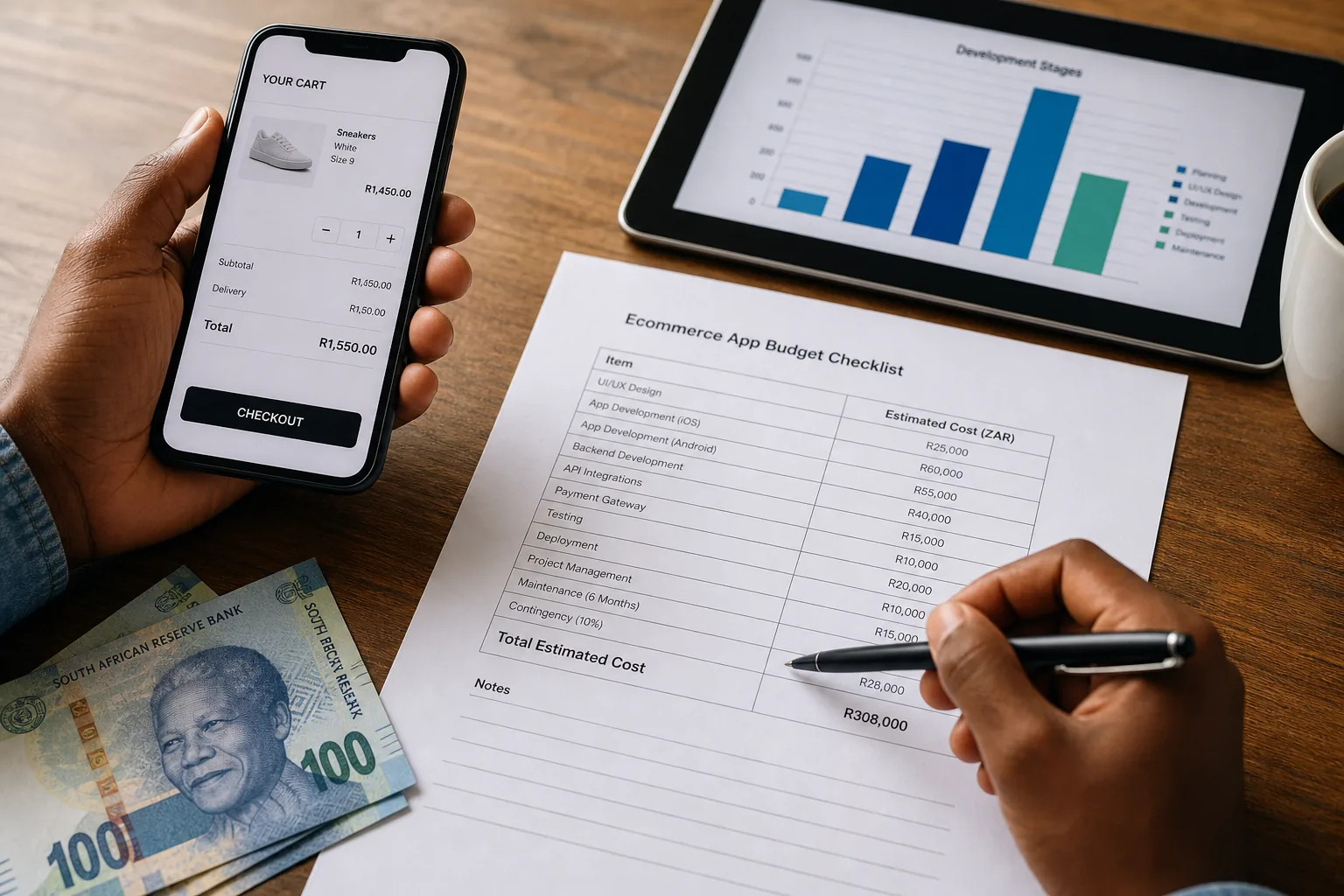
The cost of developing an eCommerce app in South Africa generally ranges between R50,000 and R1,500,000+, depending on the app complexity, features, technology stack, and business goals. A simple shopping app with basic product listings costs much less than a large marketplace app with advanced features.
This growing investment is supported by South Africa’s expanding eCommerce market. The market reached US$38.11 billion in 2025 and is projected to reach US$77.27 billion by 2034, increasing demand for mobile shopping experiences among businesses and consumers.
Many businesses make one common mistake. They look at the app screen only and estimate the budget. But the real cost comes from everything working behind it: databases, payment systems, security, order management, admin panels, and customer experience.
Here is a quick cost overview:
| App Type | Estimated Cost | Development Timeline |
|---|---|---|
| Basic MVP | R50,000–R75,000 | 2–4 months |
| Standard Business App | R75,000–R100,000 | 3–6 months |
| Advanced Marketplace | R100,000–R130,000 | 6–9 months |
| Enterprise Ecommerce | R130,000–R1,500,000+ | 9–12+ months |
Basic eCommerce App (R50,000–R75,000)
A basic MVP is designed to test an idea in the market. It usually includes essential features like product browsing, customer login, shopping cart, simple checkout, and basic payment options.
For startups, this approach often works better than building a large app from day one. It helps validate customer demand before investing heavily.
Standard Business App (R75,000–R100,000)
A standard e-commerce mobile app includes more business-focused features. These may include customer profiles, order tracking, push notifications, payment gateway integration, discount coupons, and inventory management.
This level fits growing businesses that already have customers and want a stronger mobile shopping channel.
Advanced Marketplace App (R100,000–R130,000)
Marketplace apps require more complex systems because they support multiple sellers, product categories, vendor dashboards, commissions, and advanced order management.
During product planning, businesses often underestimate marketplace complexity. Managing buyers, sellers, payments, and delivery workflows requires a strong backend foundation.
Enterprise Ecommerce App (R130,000–R1,500,000+)
Large companies usually need custom solutions connected with existing business systems. Enterprise apps may include ERP integration, CRM connections, AI recommendations, advanced analytics, loyalty programs, and high-level security.
At this stage, the focus is not only building an app. It is creating a digital commerce system that can handle thousands or millions of users.
The right budget depends on where your business is today and where you want the app to go in the next few years.
eCommerce App Development Cost Breakdown On Every Step
Understanding each development stage makes budgeting easier. The final price is not only about coding. A professional ecommerce app includes planning, design, development, testing, deployment, and ongoing improvements.
A well-planned development process helps avoid expensive changes later. In real-world ecommerce projects, businesses that spend time defining requirements early usually reduce unnecessary development costs.
| Development Stage | Estimated Cost | Development Timeline |
|---|---|---|
| Discovery & Planning | R10,000–R50,000 | 1–3 weeks |
| UI/UX Design | R20,000–R100,000 | 3–8 weeks |
| Frontend Development | R20,000–R60,000 | 6–12 weeks |
| Backend Development | R50,000–R80,000 | 8–16 weeks |
| Admin Panel | R15,000–R40,000 | 3–8 weeks |
| API Integration | R20,000–R35,000 | 2–6 weeks |
| Testing | R19,000–R25,000 | 3–6 weeks |
| Deployment | R10,000–R50,000 | 1–3 weeks |
Discovery & Planning
This is the foundation stage of an ecommerce app project. The team studies your business model, target customers, competitors, and required features.
A clear plan reduces confusion during development. Many budget problems happen because businesses start coding before deciding how the app should work.
UI/UX Design
The design stage focuses on how users interact with the app. It includes screen layouts, navigation flow, product pages, checkout experience, and visual elements.
A simple design may cost less, but ecommerce apps need smooth user journeys. A confusing checkout page can directly impact sales. Good UX design helps users find products faster and complete purchases with fewer steps.
Frontend Development
Frontend development creates the part users see and interact with. It includes product screens, search features, shopping carts, customer accounts, and order tracking.
The cost depends on the number of screens, animations, custom features, and supported platforms. A shopping app with hundreds of product categories needs more development work than a small catalog app.
Backend Development
The backend controls the core operations of the app. It manages users, products, payments, inventory, orders, and business data.
This is often one of the biggest cost areas because a strong backend supports future growth. During large ecommerce projects, teams usually invest more in backend architecture because rebuilding it later can become expensive.
Admin Panel
An admin panel allows businesses to manage daily operations. Store owners can add products, update prices, check orders, manage customers, and view reports. Without a proper admin system, even a good customer app becomes difficult to operate.
API Integration
APIs connect the app with external services. Common examples include payment gateways, shipping providers, CRM tools, ERP systems, and inventory software.
Each integration adds development time because the system needs testing, security checks, and proper data handling.
Businesses working with a South Africa ecommerce app development company often receive a detailed cost estimate for every development phase, making budgeting much easier.
Testing
Testing checks whether the app works properly across devices and situations. Teams test payments, login systems, checkout flows, speed, security, and user experience.
Skipping proper testing can create problems after launch. A small checkout issue can lead to lost sales and unhappy customers.
Deployment
Deployment includes preparing the app for launch on platforms like the Apple App Store and Google Play Store. It may also include server setup, security configuration, app publishing, and final performance checks.
A successful launch is not the finish line. Ecommerce apps need regular improvements based on customer behavior and business growth.
What Affects the Price of an eCommerce Mobile App?
The cost of an eCommerce app is not decided by the number of screens or the app’s appearance alone. The real budget depends on how the app works behind the scenes. Features, technology choices, integrations, security needs, and future growth plans all change the final price.
A small online store and a multi-vendor marketplace may look similar from the outside. But their development needs are completely different. One may need a simple shopping cart, while the other requires seller dashboards, commission systems, advanced analytics, and complex order workflows.
Understanding these cost factors helps businesses avoid budget surprises.
App Complexity
App complexity is one of the biggest factors that affects eCommerce app development cost in South Africa.
A basic shopping app with product pages, customer login, cart, and checkout requires less development time. But adding advanced features like multiple vendors, live order tracking, AI product recommendations, subscription models, or real-time notifications increases the workload.
During product planning, businesses often add many features because they want the app to feel complete from day one. This sounds good, but it can increase costs quickly.
For example, a local clothing store may only need product browsing, payments, and delivery tracking. A marketplace connecting hundreds of sellers needs much more — vendor management, payment splitting, inventory syncing, and seller reports.
A practical approach is to start with features that directly support sales. Extra features can be added after users start engaging with the app.
Features
Features directly impact the cost of building an ecommerce mobile app. Every feature needs design, development, testing, and maintenance.
Some common features that influence pricing include:
- Product catalog management
- Smart search and filters
- Shopping cart
- Secure checkout
- Payment gateway integration
- Order tracking
- Customer reviews
- Push notifications
- Loyalty programs
- Inventory management
- Seller dashboard
A simple feature may take a few days, while complex systems can take weeks.
One common challenge teams face is building features customers rarely use. For example, an advanced recommendation engine may sound impressive, but if the product catalog is small, it may not deliver enough value. The best ecommerce apps focus on solving real customer problems first.
Platform Choice: Android vs iPhone
The platform you choose also changes the overall budget. Businesses usually build for Android, iPhone, or both platforms.
Android apps can reach a large user base, while iPhone apps often attract customers who prefer premium shopping experiences. Building both versions requires more design work, development hours, and testing.
Choosing standalone iPhone app development alongside Android can increase the overall project budget because both platforms require dedicated testing and optimization.
Many startups begin with one platform or choose cross-platform development to control initial costs. However, large businesses often prefer native apps because they need better performance, deeper device features, and smoother user experiences.
The right choice depends on your audience, budget, and long-term business plans.
Custom Design
Design plays a bigger role in ecommerce success than many businesses expect.
A template-based app may reduce initial costs, but custom design helps create a shopping experience that matches your brand. It affects how users browse products, complete purchases, and return to the app.
A good ecommerce design includes simple navigation, clear product images, easy checkout, and fast access to important actions.
Businesses investing in web application development together with a mobile app usually allocate a larger budget to maintain a consistent user experience across all platforms.
For example, customers should feel the same brand experience when they shop through your website and mobile app. Different layouts or confusing navigation can reduce trust. Good design is not about adding more animations. It is about removing friction.
Backend Development
The backend is the engine behind an ecommerce app. It manages products, users, payments, orders, inventory, and business data.
Many businesses focus heavily on the customer-facing app but underestimate backend requirements. This can create problems when the business grows.
A small store may handle orders manually at first. But after thousands of customers, the system needs automation. A scalable backend supports faster order processing, better inventory control, secure customer data, multiple user roles, business reporting, and future feature expansion.
Investing in a strong backend may increase the initial ecommerce app development cost, but it can reduce expensive rebuilding later.
Third-Party APIs and Integrations
Third-party integrations can increase development costs because they connect the app with external services.
Common integrations include:
- Payment gateways
- Shipping providers
- CRM systems
- ERP software
- Marketing tools
- Analytics platforms
Each integration requires setup, testing, and security checks.
For example, adding payment options like PayFast, Stripe, or other payment providers can improve customer convenience, but developers need to make sure transactions work correctly across different situations.
Businesses should decide which integrations are essential before development begins. Too many unnecessary connections can increase both cost and maintenance work.
Developer Experience
The development team you choose also affects the project budget.
Experienced teams usually charge more because they bring better planning, stronger architecture decisions, and knowledge of common ecommerce challenges.
Experienced teams providing mobile app solutions South Africa generally charge more, but they also help reduce long-term maintenance costs through better architecture and code quality.
A cheaper development option may look attractive initially. But fixing poor code, security issues, or performance problems later can cost much more.
For growing businesses, the goal should not be the lowest development price. It should be a reliable app that supports future growth. The right team helps balance cost, quality, speed, and scalability.
Key takeaway: The cost of an eCommerce app depends on the business goals behind it. A simple shopping app may fit a smaller budget, while a marketplace or enterprise platform requires deeper investment. Planning features carefully and choosing the right technology approach can save significant costs over time.
Hidden Costs You Should Consider Before Building an eCommerce App
Many businesses only calculate the development cost and forget about what happens after launch. This is where budgets often go off track.
An eCommerce app is not a one-time investment. It needs hosting, security updates, maintenance, third-party services, and regular improvements to keep working smoothly. In real-world ecommerce projects, planning these costs early helps businesses avoid unexpected expenses later.
Here are some common hidden costs businesses should include in their budget:
| Expense | Estimated Annual Cost |
|---|---|
| Hosting & Server Costs | R5,000–R60,000+ |
| App Maintenance & Updates | R10,000–R300,000+ |
| Security & Compliance | R10,000–R150,000+ |
| App Store Accounts | R1,500–R2,000+ |
| Payment Gateway Charges | Based on transactions |
| Feature Updates & Improvements | R20,000–R100,000+ |
Hosting and Server Costs
Every ecommerce app needs a reliable hosting environment to store customer data, product information, images, and order details.
A small online store may work with basic cloud hosting. But as traffic grows, businesses usually need stronger servers, better performance, and automatic backups.
This cost is easy to miss because the app may run perfectly during launch. The challenge appears later when thousands of users visit during sales campaigns or seasonal events.
For example, a fashion store running a holiday discount campaign may suddenly receive five times more traffic. If the server cannot handle the load, customers may face slow pages or failed checkouts. Good hosting is not just a technical expense. It protects revenue.
Maintenance and Updates
Many business owners think the cost ends once the app goes live. In reality, launch is only the beginning.
Mobile operating systems change regularly. Security updates are released. Customers expect new features. Bugs appear when real users start interacting with the app.
Regular maintenance includes bug fixes, performance improvements, security patches, new feature updates, and compatibility updates.
A growing ecommerce business should keep a maintenance budget instead of waiting for problems. A small issue in checkout, login, or payment processing can directly affect sales. Teams often discover that continuous improvement costs less than fixing major problems later.
Security and Data Protection
Security is one area where businesses should never cut corners.
An ecommerce app handles sensitive information such as customer profiles, payment details, addresses, and order history.
Security costs may include SSL certificates, data encryption, security testing, backup systems, and compliance checks.
For South African businesses, customer data protection is also an important consideration because apps must handle personal information responsibly under regulations like POPIA.
A secure app builds customer trust. And trust matters a lot in online shopping.
App Store and Publishing Fees
Publishing an app also comes with small but necessary costs.
Businesses need developer accounts for platforms like Google Play and Apple App Store. They may also need professional support during submission and approval.
These costs are not usually large, but they should be part of the launch budget. A delayed app approval can also affect marketing campaigns and launch plans.
Payment Gateway Costs
Payment systems are a core part of any ecommerce app. Customers want simple and secure checkout options.
Popular payment integrations in South Africa include services like PayFast, Yoco, Peach Payments, and other payment providers. These systems may involve setup costs and transaction fees.
Many businesses focus only on development fees but forget transaction charges. For high-volume stores, even a small percentage per transaction can affect profit margins. During financial planning, payment costs should be included in the business model from the start.
Custom Features and Future Improvements
After launch, businesses usually discover new opportunities.
Customers may ask for better search, faster checkout, loyalty rewards, subscription options, or personalized recommendations.
Many businesses also invest in custom software development to connect their eCommerce app with ERP systems, CRM platforms, or inventory management software, which adds to the overall project cost.
A flexible app structure makes these improvements easier. A poorly planned system may require major redevelopment for every new feature.
The goal is not to build everything at once. It is to create a strong foundation that can grow with the business.
How to Save Money on eCommerce App Development
Building an ecommerce app does not always mean spending the maximum budget. Smart planning can reduce costs while still creating a strong product.
Many businesses overspend because they try to build everything at once. A better approach is starting with the features that directly affect customers and revenue.
Here are practical ways to control your ecommerce app development cost.
Start With an MVP
A minimum viable product helps businesses launch faster with essential features.
Instead of building a complete marketplace, start with the core shopping experience: product browsing, cart, checkout, payments, and order tracking.
After launch, customer behavior can guide future improvements. This approach reduces risk because decisions are based on real usage, not assumptions.
Avoid Unnecessary Features
More features do not always create a better app.
Sometimes a simple app with a smooth checkout performs better than a complicated app with too many options.
Before adding a feature, ask:
- Does it solve a customer problem?
- Does it increase sales?
- Will users actually use it?
Small decisions like these can save thousands in development costs.
Reuse Existing APIs
Building every system from scratch increases both time and budget.
Using trusted third-party APIs for payments, maps, notifications, or analytics can speed up development. The key is choosing reliable services that fit your business needs.
Choose a Scalable Architecture
A low-cost solution today can become expensive if it cannot support growth.
Scalable architecture allows businesses to add new features without rebuilding the complete system.
For example, a small store may start with hundreds of products but later expand to thousands. The app structure should support that growth.
Plan Long-Term Costs
The cheapest development quote is not always the best choice.
Working with experienced South Africa custom software development companies can help businesses make better technology decisions, avoid costly mistakes, and build solutions that support long-term growth.
Poor code quality, weak security, or limited scalability can create expensive problems after launch.
Understanding app development pricing before starting the project helps businesses prioritize essential features and avoid unnecessary development expenses.
A smart budget considers development, maintenance, updates, and future expansion together.
Real-World Example: How a South African Retailer Improved Customer Shopping Experience With an eCommerce App
Many businesses think an ecommerce app is only about adding products and accepting payments. But successful apps usually solve a bigger problem — making shopping easier, faster, and more convenient for customers.
A good example comes from a South African retail and wholesale group that invested in a native ecommerce app to improve the mobile shopping journey. The main goal was not just launching another sales channel. It was reducing customer frustration and creating a smoother buying experience.
The project focused on improving key areas of the customer journey, including:
- Easier account sign-in
- Faster product discovery
- Better mobile browsing
- Smooth checkout experience
- Integration with existing customer accounts
- Personalized shopping features
The team worked on removing unnecessary steps because small problems can quickly become lost sales. A customer who struggles during login or checkout may simply leave and buy somewhere else.
This is something businesses often learn after launch. The biggest ecommerce app challenges are not always technical. Sometimes the issue is simple — too many clicks, confusing navigation, or slow checkout.
What Businesses Can Learn From This Example
A successful ecommerce app starts with customer behavior, not only technology.
During planning, businesses should ask:
- Where do customers leave the buying process?
- Which steps create frustration?
- What information do shoppers need before purchasing?
- How can the app make repeat purchases easier?
For example, a clothing retailer may think adding more product filters is the priority. But customers may actually need faster checkout or better order tracking.
The feature that sounds impressive is not always the feature that creates more sales.
Small Business Example: Starting Simple Before Scaling
Consider a small South African fashion brand selling products through social media and a basic website.
Instead of building a large marketplace app with dozens of advanced features, the business starts with an MVP.
The first version includes:
- Product catalog
- Customer accounts
- Shopping cart
- Online payments
- Delivery tracking
- Push notifications
After collecting customer feedback, the business adds features like loyalty rewards, personalized recommendations, and automated marketing.
This approach controls the initial eCommerce app development cost in South Africa while allowing the business to grow step by step.
Many startups make the mistake of building the “final version” before understanding customer needs. In practice, a smaller app that customers love often creates more value than a large app filled with unused features.
Enterprise Lesson: Ecommerce Apps Become Business Systems
For larger companies, an ecommerce app is not just a shopping platform.
It becomes connected with inventory, customer data, payment systems, warehouses, and marketing tools.
South African marketplaces and retailers have shown this shift clearly. Digital commerce platforms increasingly focus on improving customer convenience, connecting multiple business operations, and supporting larger order volumes.
At enterprise level, businesses usually invest more in:
- Scalable backend systems
- Real-time inventory updates
- Advanced analytics
- Customer personalization
- Multiple payment options
- Automated workflows
The goal is simple: create a system that can handle growth without slowing the business down.
Key takeaway from this case study: The cost of an ecommerce app should always match the business stage. A startup may need a simple mobile shopping app to test demand. A growing retailer may need stronger automation. An enterprise brand may require a complete digital commerce ecosystem.
The smartest investment is not building the biggest app. It is building the right app for your customers, operations, and future growth plans.
Conclusion
The eCommerce app development cost in South Africa usually ranges from R50,000 to R1,500,000+, depending on what you want to build. A small business may start with an MVP, while larger companies need advanced systems with automation and integrations.
The best investment is not always the biggest budget. It is choosing the right features, technology approach, and development plan for your business stage. A well-planned ecommerce app can support customer growth, improve operations, and create new revenue opportunities over time.
Frequently Asked Questions
1. How much does an eCommerce app cost in South Africa?
The cost usually ranges from R50,000 to R1,500,000+, depending on features, design, platform, integrations, and business requirements.
2. How long does it take to develop an eCommerce app?
A basic app may take 2–4 months, while advanced marketplace or enterprise apps can take 6–9 months or more.
3. Can I build an eCommerce app under R100,000?
Yes, businesses can build an MVP under R100,000 with essential features like products, cart, checkout, and payments.
4. What factors affect eCommerce app development cost the most?
App complexity, features, platform choice, backend requirements, integrations, security, and developer expertise impact the final cost.
5. Should I build an Android or iPhone eCommerce app first?
The choice depends on your target users, budget, and business goals. Many startups begin with one platform.
6. What features increase eCommerce app development costs?
Advanced features like AI recommendations, multi-vendor support, ERP integration, analytics, and real-time tracking increase development costs.
7. Are there hidden costs after launching an eCommerce app?
Yes, businesses should budget for hosting, maintenance, security updates, app store fees, and future feature improvements.
8. How can businesses reduce eCommerce app development costs?
Starting with an MVP, prioritizing key features, using APIs, and choosing scalable technology can help control costs.