Looking for a straight answer on POS (point-of-sale) development cost in South Africa? Good, because this guide skips the sales pitch and gets right into it.
Retail stores, restaurants, pharmacies, supermarkets, and multi-location chains all pay different amounts, and the gap comes down to features, integrations, security needs, and how the system gets deployed.
Below is a realistic pricing breakdown, the factors that push costs up or down, and a few budgeting tips that actually hold up in the real world.
- POS development costs range from R50,000 to R1.5 million+, depending on project scope.
- Business size, features, integrations, and compliance have the biggest impact on development costs.
- Custom point-of-sale (POS) systems offer better flexibility and long-term value than ready-made software.
- Budget for maintenance, hosting, integrations, and support beyond the initial development cost.
- Compare experienced South African development companies before making a long-term investment.
How Much Does POS Development Cost in South Africa?
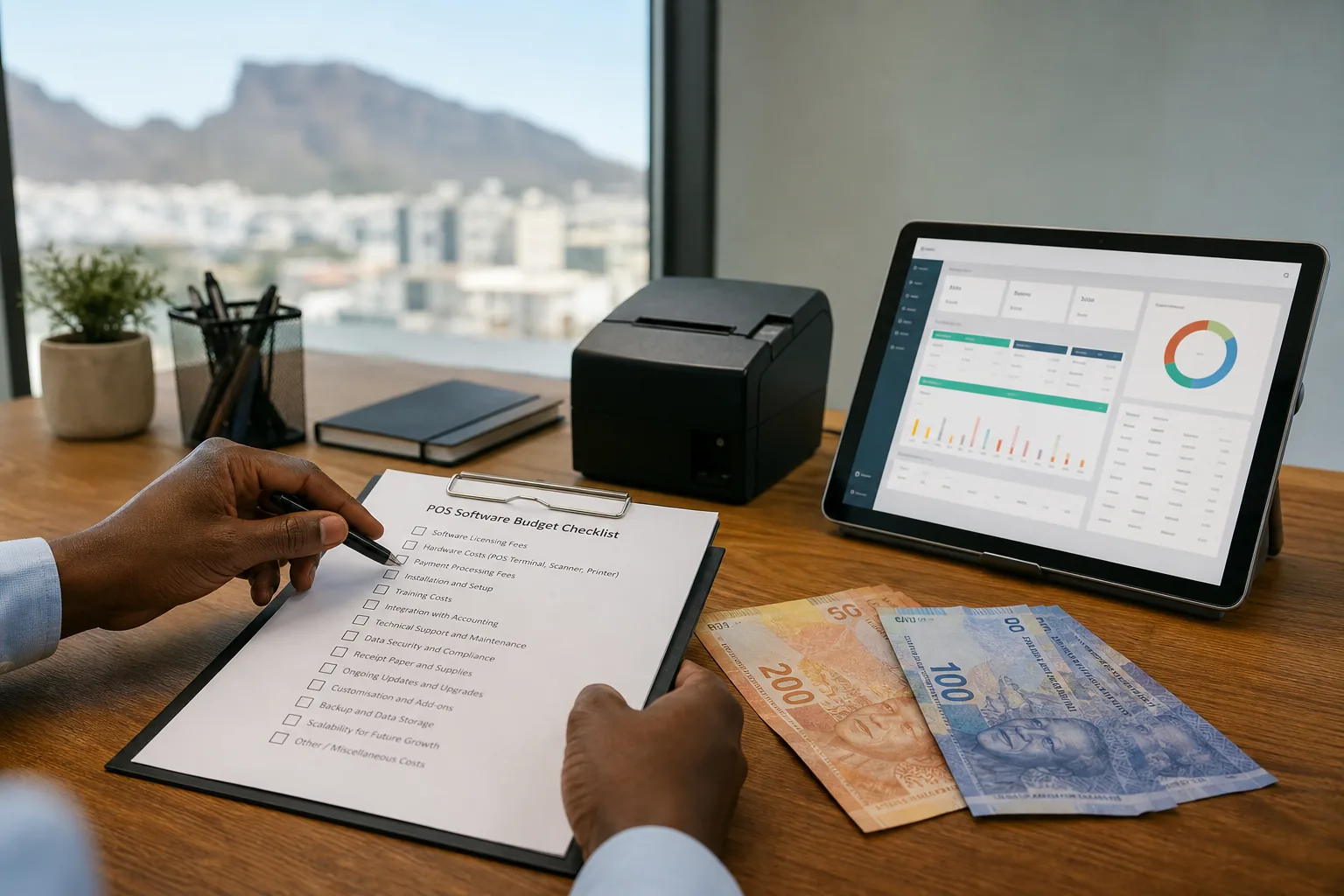
There's no single number that fits every business, and anyone who quotes one flat price before asking about your operation is guessing. Cost depends on how many features you need, how many locations you're running, and how deep the integrations go.
A township spaza shop needs something completely different from a Woolworths-style supermarket chain. One needs a till, a barcode scanner, and basic stock counts. The other needs real-time sync across branches, supplier management, and reporting that satisfies SARS at tax time.
Here's the general split by business size.
| Business Size | Estimated Cost (ZAR) | Timeline | Ideal For |
|---|---|---|---|
| Micro / Solo | R50,000 – R100,000 | 8–10 weeks | Kiosks, small township stores |
| Small Business (Basic POS) | R100,000 – R250,000 | 10–14 weeks | Single-location retail or cafes |
| Medium Business (Standard POS) | R250,000 – R550,000 | 14–22 weeks | Restaurants, pharmacies, small chains |
| Large Business (Advanced POS) | R550,000 – R1,000,000 | 22–30 weeks | Supermarkets, franchises |
| Enterprise POS | R1,000,000 – R1,500,000+ | 30–40 weeks | National retail chains, wholesalers |
Development companies price by hours, features, and complexity, not by guesswork. A vendor who can't explain why your quote is what it is probably hasn't thought it through either.
Feature-Based Cost Breakdown for Custom POS Software
This is where most budgets actually get built or broken. Features stack, and each one carries its own cost weight depending on how complex it is to build and maintain.
| Feature | Complexity | Explanation |
|---|---|---|
| Inventory Management | Low | Tracks stock levels, updates inventory in real time, and prevents overselling or stock shortages. |
| Barcode Scanning | Low | Speeds up product lookup, billing, and inventory updates using barcode scanners or mobile devices. |
| Receipt Printing | Low | Prints digital or paper receipts with order details, taxes, and payment information instantly. |
| CRM / Customer Records | Medium | Stores customer profiles, purchase history, and preferences to improve service and repeat sales. |
| Cloud Sync | Medium | Syncs sales, inventory, and customer data across devices and locations in real time. |
| Customer Loyalty Programs | Medium | Rewards repeat customers with points, discounts, offers, and exclusive membership benefits. |
| Employee Management | Medium | Manages staff roles, permissions, attendance, and sales performance from one dashboard. |
| Supplier Management | Medium | Tracks suppliers, purchase orders, deliveries, and inventory replenishment efficiently. |
| Tax / VAT Management | Medium | Automatically calculates VAT, taxes, and generates compliant invoices and tax reports. |
| Payment Gateway Integration | Medium | Supports secure card, digital wallet, and contactless payments with multiple providers. |
| Reporting Dashboard | Medium | Displays sales, revenue, inventory, and business performance through real-time reports. |
| Accounting Integration | High | Syncs transactions with accounting software to automate bookkeeping and financial reporting. |
| Offline Mode | High | Allows sales to continue without internet and syncs data automatically when online. |
| Multi-Store Sync | High | Synchronizes inventory, pricing, and sales across multiple store locations in real time. |
| Mobile POS | High | Lets staff process payments from smartphones or tablets. Mobile functionality can also increase overall mobile app development cost. |
| AI Analytics | Very High | Uses AI to forecast demand, identify sales trends, and provide business insights automatically. |
Inventory tracking and barcode systems sit at the cheap end because they're standard, well-understood builds. Offline mode is trickier than people expect. It means the system has to keep working during load-shedding or a dropped connection, then sync everything back up without duplicating a single sale. That kind of reliability takes real engineering time.
AI analytics sits at the top for a reason. Predicting stock-outs, flagging slow-moving items, or forecasting seasonal demand requires data modeling that goes well beyond a standard checkout build. Multi-store businesses often ask for this once they've outgrown spreadsheets, and it usually pays for itself within a year or two through fewer stockouts and less wasted inventory.
Factors That Influence Custom POS Software Pricing
Price doesn't move randomly. A handful of factors decide where a project lands on the scale, and most business owners can predict their own budget once they understand these.
Business Complexity
More locations, more product categories, and more staff roles all mean more logic the system has to handle. A single-till spaza shop and a five-branch supermarket chain are not the same build, not even close.
Cost: +R30,000 – R400,000
Custom Features
Off-the-shelf modules cost less than anything built from scratch. If your business has a workflow no template covers, that's custom work, and custom work takes longer to plan and test.
Cost: +R20,000 – R300,000
Cloud Deployment
Modern POS platforms often run as secure web-based systems. Businesses comparing web application development services should also consider hosting, security, scalability, and long-term maintenance when planning their budget. On-premise setups skip the monthly hosting fee but often need pricier hardware upfront.
Cost: +R15,000 – R120,000
Third-Party Integrations
Every integration, whether it's a payment gateway, an accounting platform, or a delivery app, adds development and testing time. Two systems talking to each other reliably is harder than it sounds.
Cost: +R10,000 – R200,000
Offline Functionality
Load-shedding isn't going away anytime soon, and South African businesses know it. Offline-capable POS systems need local data storage and smart sync logic, which adds real cost.
Cost: +R40,000 – R180,000
Security
Card data, customer records, and sales history all need protection. Encryption, secure logins, and regular security testing aren't optional extras — they're baseline requirements.
Cost: +R20,000 – R150,000
Compliance
SARS-aligned VAT reporting, POPIA data protection rules, and industry-specific compliance (like pharmacy record-keeping) all shape how the system gets built from day one.
Cost: +R15,000 – R100,000
UI/UX
A cashier working a lunch rush needs a fast, simple interface. Clunky screens slow down checkout lines and frustrate staff, so good design work costs money but saves time daily.
Cost: +R20,000 – R120,000
Technology Stack
The programming languages and frameworks a developer chooses affect both build speed and long-term maintenance. Modern, well-supported stacks tend to cost more upfront but save money later.
Cost: +R20,000 – R180,000
Development Company
Rates vary. A freelance developer charges less than an established software company, but experience, support quality, and long-term reliability usually track with price.
Cost: Can change total project cost by 20–50%
Testing
Thorough testing across devices, payment methods, and edge cases (like a card declining mid-transaction) takes real hours. Skipping this stage shows up later as bugs at the till.
Cost: +R20,000 – R120,000
Maintenance
Ongoing updates, bug fixes, and feature additions after launch all cost money. Budgeting for this after go-live, not just before it, is where a lot of business owners get caught off guard.
Cost: 10–20% of development cost per year
Custom vs Ready-Made POS Systems: Which Offers Better Value?
This decision shapes the entire budget conversation, so it's worth laying out side by side.
| Factor | Ready-Made POS | Custom POS |
|---|---|---|
| Upfront Cost | Lower | Higher |
| Customization | Limited | Full control |
| Scalability | Restricted by vendor | Built to grow with the business |
| Ownership | Rented / licensed | Fully owned |
| Security | Shared, vendor-controlled | Business-controlled |
| Maintenance | Vendor-managed, recurring fees | Business-managed, flexible |
| Business Growth | May require switching later | Grows alongside the business |
Ready-made POS software works fine for a single small store that doesn't plan to expand much. Monthly subscription fees are lower to start, and setup is quick. But franchise owners, supermarkets, and multi-location businesses often hit a wall with off-the-shelf software once they need something the vendor simply doesn't offer.
Businesses investing in custom software development in South Africa often choose a custom POS because it fits their daily operations, supports future growth, and removes the limits that come with subscription-based platforms. No monthly licensing surprises, no forced upgrades, and no waiting on a vendor's roadmap to get a feature built. For businesses planning to scale across Johannesburg, Cape Town, Durban, or beyond, that ownership tends to pay off within a few years.
POS Software Development Cost Across Different Industries
Different industries carry different cost drivers. Here's how pricing tends to break down across sectors.
- Retail — R80,000 – R450,000. Independent retailers and franchise stores need inventory tracking, barcode systems, and often loyalty integrations tied to South African payment gateways like Ozow or SnapScan.
- Restaurants — R120,000 – R350,000. Many hospitality businesses combine POS software with restaurant app development for online ordering, reservations, loyalty programs, and kitchen management, which increases the total project budget. Delivery integration adds further cost.
- Hospitality — R300,000 – R900,000. Hotels and hospitality groups need POS systems that talk to booking platforms, room service billing, and multiple revenue points under one roof.
- Healthcare — R250,000 – R700,000. Clinics and healthcare providers need patient billing tied into medical aid processing, which adds compliance layers most standard POS builds skip entirely.
- Pharmacy — R220,000 – R500,000. Batch and expiry tracking, prescription logging, and SARS-compliant reporting keep this category firmly in mid-to-high territory.
- Salon — R60,000 – R180,000. Appointment booking tied to checkout, staff commission tracking, and product inventory cover most salon needs without pushing costs too high.
- Warehouse — R350,000 – R800,000. Bulk stock movement, supplier ordering, and barcode-driven warehouse management systems dominate here.
- Automotive — R200,000 – R550,000. Service centers and parts retailers need job card tracking alongside standard checkout functionality, which adds development complexity beyond a typical retail build.
Estimate Your POS Software Budget with This Cost Calculator
Here's a real-world example to make this concrete.
Scenario: A retail chain with 3 store locations wants inventory management, accounting integration, payment gateway support, CRM, and a reporting dashboard.
| Requirement | Included |
|---|---|
| Store Locations | 3 |
| Inventory Management | Yes |
| Accounting Integration | Yes |
| Payment Gateway | Yes |
| CRM | Yes |
| Reporting Dashboard | Yes |
Estimated Cost: R450,000 – R650,000
Estimated Timeline: 16–20 weeks
Add mobile POS for staff on the floor, and that pushes toward R700,000. Drop accounting integration, and it comes back down closer to R380,000. This is roughly how development companies build a quote, feature by feature, not by picking a number out of thin air.
Hidden Expenses to Consider Before Building a POS System
The development quote is rarely the full picture. A few costs tend to sneak up on business owners after launch.
- Hosting fees for cloud-based systems, billed monthly or annually
- Cloud storage costs that scale with transaction volume
- API fees from payment gateways, online ordering tools, or eCommerce platforms can increase ongoing costs. These integrations are often similar to the factors that influence e-commerce app development cost, especially when real-time inventory syncing is required.
- Software licenses for certain hardware or backend tools
- Ongoing support contracts beyond the initial build
- Maintenance for bug fixes and security patches
- Staff training time, which is easy to underestimate
- Hardware compatibility costs if existing tills or scanners need replacing
- Security updates to stay ahead of new threats
- Compliance updates whenever SARS or POPIA rules shift
Budgeting an extra 15 to 20 percent on top of the development quote for these ongoing costs saves a lot of stress in year one.
Practical Ways to Reduce POS Software Development Expenses
Cutting corners on security or core functionality backfires. Cutting scope, on the other hand, is smart budgeting.
- Start with an MVP. Build the core checkout and inventory features first, add extras later.
- Choose scalable architecture. Paying slightly more upfront for a system that grows with you beats rebuilding in two years.
- Skip unnecessary modules. A single-store cafe doesn't need multi-branch sync on day one.
- Hire experienced developers. Cheaper quotes often mean more bugs and slower delivery down the line.
- Reuse existing APIs instead of building custom integrations from scratch where possible.
- Plan integrations early. Bolting on a payment gateway after launch costs more than including it in the original build.
- Consider cloud hosting over on-premise servers to lower upfront hardware costs.
- Use phased development. Roll features out in stages instead of launching everything at once.
Why South African Businesses Invest in Custom POS Solutions
Retail growth across South Africa keeps pushing more independent stores and franchises toward digital checkout systems. Cash-only setups are fading, and digital payments through PayFast, Ozow, Yoco, SnapScan, and Peach Payments have become standard expectations, not nice-to-haves.
Multi-location businesses in particular struggle with generic software once they cross two or three branches. Local compliance adds another layer that off-the-shelf international POS tools often handle poorly. VAT rules through SARS, and reporting formats expected by South African accountants don't always match what a foreign-built system assumes by default.
Inventory accuracy matters more in a market where stock delays hit harder than they do elsewhere. Customer loyalty programs, tailored for South African shopping habits rather than copied from an American template, tend to perform better with local retailers too. Township businesses, independent stores in Polokwane or Bloemfontein, and franchise chains across Gauteng all lean toward custom builds once they need software that actually understands the market they're operating in.
Choosing the Right POS Development Company in South Africa
A checklist helps here more than a long explanation.
Experience matters more than a long client list. A website development company that has delivered POS platforms or business software is usually better equipped to handle complex retail operations than a team focused only on marketing websites. Working with a dedicated POS development company in South Africa can also help with payment integrations, offline mode, and multi-store sync.
- Portfolio: Ask to see live examples, not just mockups or screenshots.
- Industry expertise: A company that's built pharmacy POS systems understands compliance far better than one that hasn't.
- Support availability: Find out what happens when the till goes down on a Saturday afternoon.
- Maintenance plans: Clarify what's included after launch and what costs extra.
- Tech stack: Ask what the system is built on and whether it's easy to update later.
- Client reviews: Independent feedback tells you more than a sales pitch ever will.
- Pricing transparency: A company that explains its quote line by line is worth more trust than one that just gives a flat number.
- Local knowledge: Familiarity with SARS requirements and South African payment gateways saves headaches later.
- Security practices: Ask directly how customer and payment data gets protected.
Conclusion
POS development cost in South Africa ranges from around R50,000 for a basic single-store setup to R1,500,000 and beyond for enterprise-grade systems with AI analytics and multi-branch sync. Where a business lands on that scale depends on size, feature list, industry compliance needs, and whether the build is custom or ready-made.
The smartest approach starts with a clear picture of actual business needs, not a wish list of every feature available. Budget for maintenance and hidden costs alongside the initial quote, not as an afterthought. A pharmacy in Durban and a supermarket chain in Gauteng will never pay the same price, and that's exactly how it should work. Ready to figure out what your business actually needs? Reach out to a development team that can walk through the numbers with you, line by line.
Frequently Asked Questions
How much does POS software cost in South Africa?
Basic systems start around R50,000, while enterprise solutions can exceed R1.5 million. Most SMEs spend R150,000–R550,000.
How long does POS development take?
A basic POS takes 8–10 weeks. Advanced systems for restaurants, pharmacies, or chains usually need 14–40 weeks, based on complexity.
Can I integrate payment gateways?
Yes. Most custom POS systems support Yoco, PayFast, Ozow, SnapScan, and Peach Payments, based on your business needs.
Can POS systems work offline?
Yes. An offline POS keeps sales running during load-shedding or internet outages, then syncs data automatically when the connection returns.
How much does POS maintenance cost?
Annual maintenance usually costs 10%–20% of the development budget. It covers updates, security patches, bug fixes, and ongoing support.
Can I upgrade my POS system later?
Yes. Custom POS software makes future upgrades easier, so you can add features, users, or new branches as your business grows.
Is cloud POS cheaper than on-premise?
Cloud POS has lower upfront costs but includes hosting fees. On-premise costs more to set up but has fewer recurring platform charges.
What industries benefit most from custom POS software?
Retail, restaurants, pharmacies, supermarkets, warehouses, and franchise businesses gain the most from custom POS software built for their workflows.