Your fridge stops working during load shedding and nobody knows until the stock spoils. Sound familiar?
That is the real cost of running a business blind. IoT app development services in South Africa exist to fix exactly this kind of problem. They connect your devices, your data and your team so nothing runs on guesswork anymore.
In this blog, we will walk you through what these services actually include, how the apps work, what they cost and how to pick the right partner.
What is IoT App and How Does It Work
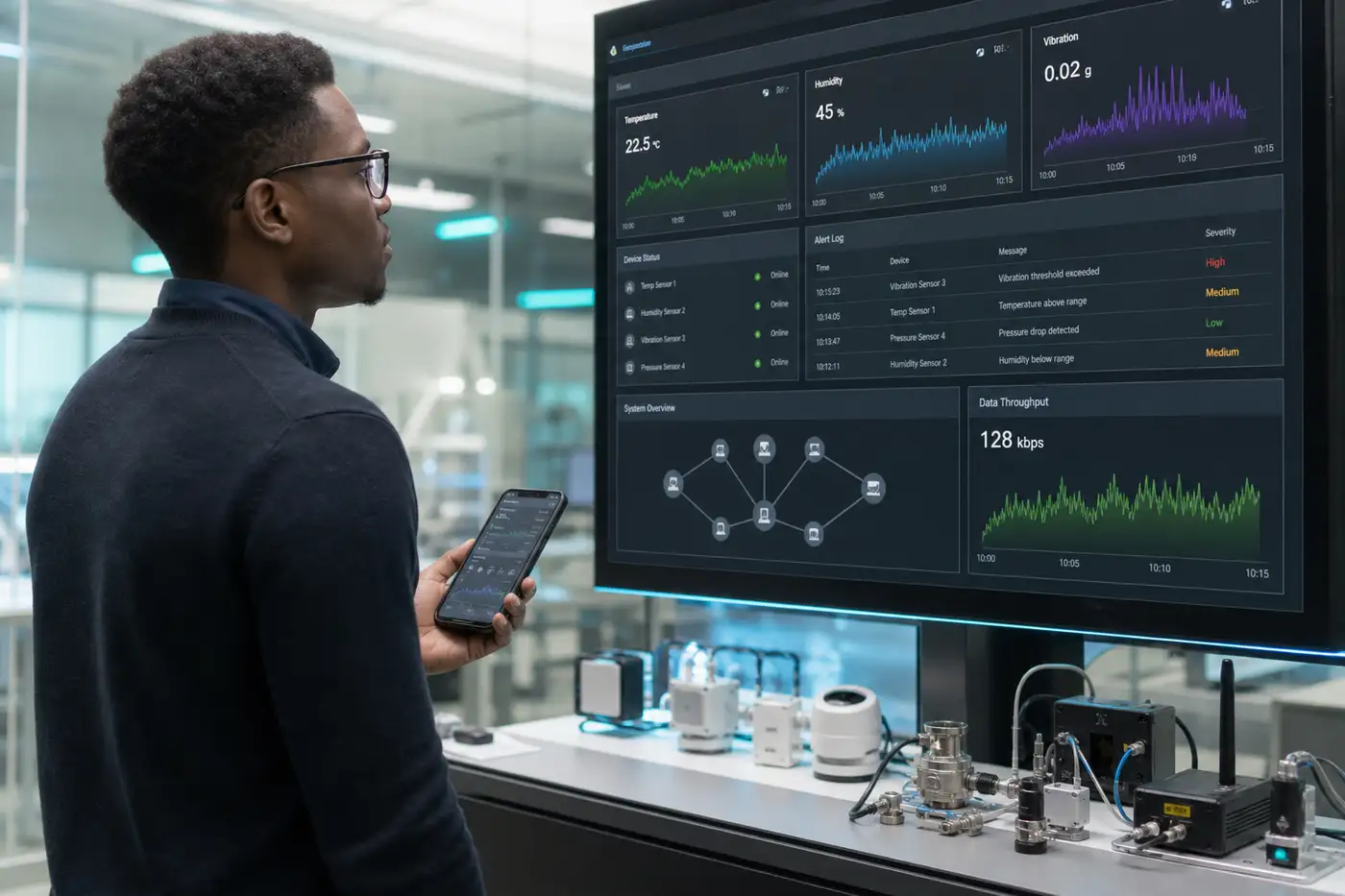
An IoT app connects smart devices, sensors, machines, vehicles, or equipment with a mobile or web application. It collects real time data, sends it through a secure network, processes it in the cloud, and gives users visibility, alerts, analytics, and remote control from a single dashboard.
Satellite and hybrid IoT connectivity in South Africa is forecast to grow at 20.74% annually through 2031, driven by load shedding challenges and rural coverage gaps that require reliable backup connectivity when traditional networks are unavailable.
How It Works
Step 1. Smart Devices Collect Data
IoT sensors, GPS trackers, smart meters, cameras, or industrial equipment capture real time data such as temperature, location, vibration, energy usage, or machine health.
Step 2. Connectivity Transfers Information
Data moves through WiFi, Bluetooth Low Energy, NB IoT, LoRaWAN, 4G, 5G, or satellite networks, depending on coverage, distance, and power requirements.
Step 3. IoT Platform and Cloud Process Data
Platforms like AWS IoT, Azure IoT Hub, and Google Cloud IoT receive device data, manage connected assets, and run analytics or automation workflows.
Step 4. APIs Deliver Insights to the App
Backend systems, APIs, databases, and device management services organize sensor data and securely deliver it to mobile or web applications.
Step 5. Users Monitor and Control Devices
The IoT app displays dashboards, alerts, predictive maintenance insights, asset tracking, and remote device controls so teams can act instantly.
Key Features of IoT Mobile Applications
Not every IoT app needs every feature under the sun. But a few show up again and again, and for good reason.
- Real time device monitoring lets you see what is happening right now, not an hour ago.
- Remote device control lets you switch things on or off from anywhere, which saves a trip to site.
- Push notifications and alerts warn you the moment something goes wrong, like a temperature spike in a cold storage unit.
- Device status tracking shows whether a unit is online, offline or running low on battery.
- Data dashboards turn raw numbers into something you can actually read at a glance.
- Location tracking matters a lot for fleets and delivery businesses.
- User and role management keeps the wrong hands off the wrong controls.
- Automated workflows are underrated. If a sensor detects a fault, the system can trigger a maintenance ticket on its own, no human needed to notice first.
- Predictive maintenance goes a step further, warning you before a machine actually breaks.
- Offline functionality also deserves attention, because South African connectivity is not always steady, and an app that stops working the second WiFi drops is not much use to anyone.
Benefits of IoT App Development for South African Businesses
Let us talk about value, not just features. A logistics company using a connected vehicle app can see fuel usage, location and vehicle health from one screen, without a single phone call to the driver.
Real Time Visibility
Real time operational visibility is probably the biggest win. You stop reacting to problems after they happen and start catching them early. Remote monitoring and control save time and money, especially for businesses managing sites across provinces.
Predictive Maintenance
Predictive maintenance reduces the panic of sudden equipment failure. Better asset utilisation means fewer machines sitting idle without anyone noticing. Faster decision making happens naturally once the right data lands in front of the right person.
Smarter Decisions
In our view, remote visibility often matters more than collecting more sensor data. Data only becomes useful once someone actually acts on it quickly. A dashboard full of numbers nobody checks is just noise.
Growing IoT Market
The bigger South African IoT picture backs this up. The local IoT market is expected to grow from about USD 4.85 billion in 2026 to roughly USD 8.86 billion by 2031, growing at 12.8 percent a year, driven by cloud adoption, improving spectrum access and nationwide 5G rollout. Source: Mordor Intelligence South Africa IoT Market Report.
That kind of growth tells you this is not a passing trend. Businesses across the country are already investing, and the ones who wait too long risk falling behind competitors who acted early.
IoT App Development Use Cases in South Africa
Numbers are one thing. Real examples make it click. Here are the industries where IoT app development services genuinely move the needle.
Smart manufacturing
Sensors sit on machines and production lines, watching temperature, vibration and output. A mobile dashboard lets a plant manager check machine health from their office instead of walking the floor every hour.
Fleet and logistics management
GPS trackers and vehicle sensors send location, fuel and engine data straight to a mobile app. Fleet and asset tracking already makes up about 24.40 percent of South Africa's IoT application spend, and mining trucks and cold chain trailers rely on it daily. Source: Mordor Intelligence South Africa IoT Market Report.
Agriculture
Soil moisture, weather and irrigation sensors feed data into a farmer's phone. Research into IoT readiness in South African agriculture points to internet access and mobile infrastructure as key factors shaping adoption in this sector.
Healthcare
Connected medical devices can transmit patient vitals or equipment status straight to a monitoring app, cutting down response time in critical situations.
Energy and utilities
Smart meters and monitoring devices track electricity and water consumption in real time, which matters a great deal given how often load shedding disrupts normal operations.
Smart buildings
Connected lighting, HVAC and security systems can all be managed from one mobile interface, saving both energy and staff time.
Mining and industrial operations
Remote monitoring becomes essential where assets sit in dangerous or hard to reach locations. A sensor doing the checking beats sending a person underground just to read a gauge.
How to Develop an IoT Mobile App
There is a process here, and skipping steps almost always costs more later.
1. Define the Business Use Case
Start with the problem, not the app features. Decide what the connected system needs to monitor, automate or control, then define the users and business outcome. For example, a logistics company may want vehicle tracking, fuel monitoring and maintenance alerts in one IoT mobile application.
Useful questions include:
- What devices need to be connected?
- What data needs to be collected?
- Who needs access to it?
- What action should happen when a reading changes?
A clear use case keeps the IoT development project focused before hardware or software decisions begin.
2. Select Devices and Sensors
Once the use case is clear, choose the sensors, trackers, gateways or actuators that can actually collect and respond to the required data. This sounds simple until you test hardware in the real world. Battery life, sensor accuracy, environmental conditions and device compatibility all matter.
For example, a cold storage business may need temperature sensors that continue recording during connectivity interruptions rather than relying on a constant cloud connection.
3. Plan IoT Connectivity
Connectivity determines how reliably device data reaches the application. The right option depends on location, range, power consumption and data volume.
A South African farm may benefit from LoRaWAN or NB IoT for low power monitoring, while an urban fleet could use 4G or 5G. Remote sites may also require satellite or hybrid IoT connectivity.
Poor connectivity planning is one of those problems that looks harmless during development and becomes painfully obvious after deployment.
4. Design the IoT Architecture
Now map the complete data journey from the physical device to the person using the application. This includes sensors, gateways, communication protocols, IoT platforms, cloud infrastructure, backend services, APIs and databases.
A typical architecture may look like:
Sensor → Connectivity → Gateway → IoT Platform → Backend → API → Mobile App
This stage also defines device provisioning, authentication, data processing and how the system will scale when ten devices become hundreds or thousands.
5. Design the Mobile App Experience
The mobile app should turn complicated IoT data into something people can understand quickly. A plant manager does not need to stare at raw sensor readings. They need to know which machine is failing and what needs attention.
The interface may include:
- Real time monitoring dashboards
- Device status
- Push notifications
- Location tracking
- Sensor readings
- Remote device controls
- Reports and analytics
Offline functionality should also be considered where network coverage is unreliable. Local data caching can keep essential information available until the connection returns.
6. Build the Backend and APIs
The backend becomes the bridge between the IoT ecosystem and the application. Developers build APIs and business logic that receive device data, process events, store information and deliver relevant updates to authorised users.
Technologies such as Node.js, Python, Java, REST APIs, MQTT, WebSockets, PostgreSQL and MongoDB may fit different project requirements. The choice should follow the architecture, not the developer's favourite technology.
7. Integrate the IoT Platform and Devices
This is where the software starts talking to real hardware. Devices are registered, authenticated and connected to the IoT platform. Sensor data is ingested, processed and routed to the backend or analytics layer.
For example, AWS IoT Core or Azure IoT Hub can support device connectivity and management, while the application consumes processed information through secure APIs.
It is also where small hardware quirks tend to appear. A sensor may send duplicate readings. A device may disappear from the network. Real testing catches those things early.
8. Test the Complete IoT System
Testing an IoT application means testing more than screens and APIs. The team needs to check how hardware, connectivity, cloud services and mobile applications behave together.
Important tests include:
- Device connectivity
- Sensor accuracy
- Offline operation
- Data synchronisation
- API reliability
- Security and authentication
- Device provisioning
- Load and scalability
- Network interruption recovery
Imagine a mining site losing connectivity for twenty minutes. What happens to the readings collected during that period? A good IoT system already has an answer.
9. Deploy and Monitor
Once testing is complete, deploy the application and connected devices in a controlled environment before expanding the rollout. Monitor device health, application performance, network reliability, cloud resources and unusual data patterns.
A phased deployment can expose problems with a small device group before they affect an entire operation. That is usually a much cheaper lesson to learn.
10. Maintain and Scale the IoT App
IoT development does not really end at launch. Devices need firmware updates, security patches and lifecycle management. Cloud infrastructure may need scaling as the number of connected devices and volume of sensor data increases.
If your business wants to validate the idea before committing to a full production system, MVP mobile app development can be a practical starting point. You can test the core workflow with a limited number of devices, learn what users actually need and scale from there.
One mistake we see often is treating the mobile app as the whole product. It is only one layer. If device provisioning, connectivity, data handling or security are poorly planned, a beautiful app screen cannot save the project.
Common IoT App Development Mistakes to Avoid
We have watched a few projects stumble over the same issues, again and again.
- Starting with features before defining the actual business problem wastes time and budget.
- Choosing hardware before understanding requirements often leads to expensive rework later.
- Ignoring connectivity limitations is a big one in South Africa specifically, given how uneven coverage can be outside major cities.
- Underestimating device security leaves the whole system open to attack, and IoT devices are frequent targets.
- Building without a scalability plan means the app that worked fine for ten devices falls over the moment you add two hundred.
- Ignoring offline scenarios causes real frustration when connectivity drops mid task.
- Treating mobile and IoT systems as separate projects almost guarantees integration headaches down the line.
- Collecting data without deciding how it will actually be used just fills up storage with numbers nobody reads.
IoT App Development vs Traditional Mobile App Development
People often assume IoT app development and traditional mobile app development are the same thing with extra steps. They are not, and understanding the difference will save you a difficult conversation with a developer later.
| Factor | Traditional Mobile App | IoT Mobile App |
|---|---|---|
| Main Data Source | APIs and databases | Sensors and connected devices |
| Hardware | Usually optional | Core part of the system |
| Connectivity | Mainly internet | Internet, MQTT, BLE, 4G, 5G |
| Data | User and application data | Real time sensor and device data |
| Device Control | Limited | Remote monitoring and control |
| Architecture | App, backend, database | Devices, gateway, cloud, backend, app |
| Security | App and backend | Device, network, cloud and app |
| Maintenance | Software updates | Software, hardware and device lifecycle |
| Offline Needs | Useful in some apps | Often critical for remote deployments |
What Affects IoT App Development Cost in South Africa
The cost of IoT app development in South Africa can range from ZAR 50,000 to ZAR 1,500,000+.
| IoT App Type | Estimated Cost | Timeline |
|---|---|---|
| Basic IoT MVP | ZAR 50,000 to ZAR 200,000 | 6 to 10 weeks |
| Standard IoT App | ZAR 200,000 to ZAR 500,000 | 10 to 16 weeks |
| Advanced IoT Solution | ZAR 500,000 to ZAR 1,000,000 | 4 to 7 months |
| Enterprise IoT Platform | ZAR 1,000,000 to ZAR 1,500,000+ | 6 to 12+ months |
How to Choose IoT App Development Services in South Africa
This is the part where a lot of businesses feel stuck. So many mobile app development companies in South Africa claim they can build anything. Here is a simple checklist to cut through the noise.
- Look for genuine IoT architecture experience, not just mobile app portfolios.
- Ask specifically about device integration work they have done before.
- Check how seriously they take security, since a weak IoT system is an easy target.
- Review their cloud capabilities and their Android and iOS expertise.
- Ask how they plan for scalability as your device count grows.
- Look at previous IoT projects, not just generic app screenshots.
- Ask about support after launch, because IoT systems need ongoing monitoring far more than a typical app.
- Understand who owns the source code and intellectual property before signing anything.
Businesses comparing local vendors often look at companies first, then narrow the list down based on who actually has IoT specific experience.
The right IoT app development company should manage the full ecosystem, not just the mobile screen sitting on top of it.
Real IoT App Development Experience and Lessons Learned
On one project, a client wanted a mobile app to monitor equipment across several sites. Devices sat in areas with patchy connectivity, and early testing kept failing because the app assumed a stable connection at all times.
We had to rebuild parts of the offline handling and add local data caching so readings would sync once the connection returned. It slowed the timeline down, but it saved the client from a system that would have failed the moment coverage dropped.
The biggest lesson from that project was simple. Device reliability mattered more than adding another dashboard feature. A flashy chart means nothing if the underlying data never arrives in the first place.
Conclusion
IoT App Development Services in South Africa are not about chasing a trend. They are about knowing what is happening in your business right now, not hours later.
From farms to fleets to factory floors, connected apps are quietly changing how local businesses make decisions.
If you are thinking about building one, start with the problem you actually want to solve, not the features you think you want. That is where every good IoT project begins.
Ready to scope a connected build? Explore our IoT app development company in South Africa services.
FAQs
What do IoT app development services include?
They include device integration, mobile app development, backend and API development, cloud integration, data analytics, device management and security, all working together as one system.
How long does it take to build an IoT app?
It depends on device count and complexity, but most projects range from a few months for an MVP to six months or more for a full production system.
Do IoT apps work without internet?
Good ones do, at least partially. Offline functionality with local data caching keeps core features working until connectivity returns.
Which industries in South Africa use IoT apps the most?
Fleet and logistics, agriculture, mining, manufacturing, healthcare and energy are among the biggest users right now.
Is IoT app development more expensive than a normal app?
Usually yes, because it involves hardware integration, connectivity planning and extra security layers on top of standard app development.