You want to build a grocery delivery app. Good. But there is one question sitting in your head right now, and it will not go away.
How much money do you actually need?
Not a rough guess. A real number.
I have watched founders lose sleep over this exact question. Some spend months planning features and then panic when they see the first quote from a development team. Others spend too little on research and end up rebuilding half the app a year later.
This guide breaks down the real grocery delivery app development cost in South Africa, with honest ranges, clear reasons behind the numbers, and a few hard lessons learned the slow way. By the end, you will know exactly what drives the price up or down.

What Is the Actual Meaning of a Grocery Delivery App, and Why Should You Invest in It?
A grocery delivery app is a digital platform that lets customers browse products, check stock, place orders, make payments, and track deliveries while stores manage inventory, fulfilment, delivery partners, and customer relationships from one connected system.
A specialist grocery delivery app development company in South Africa can help you decide whether you need a single-store MVP or a full marketplace.
Why Invest in Grocery Delivery App Development?
South Africa's online grocery market could hit R80bn in 2026 and R120–130bn by 2029. E-commerce users are projected to rise from 11.7m in 2025 to 21.52m by 2029.
- Expand digital reach: Serve customers beyond your physical store through online grocery ordering and location-based delivery.
- Increase repeat purchases: Use order history, personalised recommendations, loyalty programmes, and push notifications to encourage frequent shopping.
- Improve inventory visibility: Real-time stock synchronisation helps reduce unavailable products, substitutions, and fulfilment errors.
- Create new revenue streams: Combine delivery fees, vendor commissions, subscriptions, featured products, and convenience charges.
- Streamline fulfilment: Connect order management, picking, packing, dispatch, GPS tracking, and proof of delivery in one workflow.
- Understand customer behaviour: Analyse basket size, purchase frequency, product preferences, cart abandonment, and customer lifetime value.
Grocery App Development Cost by Business Model
Not every grocery app is the same animal. The business model changes everything about the price tag.
Single Store Grocery App
One shop. One product list. One person managing stock.
This is the simplest and cheapest model to build. If you already run a store and just want customers to order online, this is where most people should start.
Cost: ZAR50,000 to ZAR250,000
Multi-Vendor Grocery Marketplace
Now imagine many small shops selling through one app, like a digital version of a local market.
You need vendor onboarding, a vendor dashboard, commission tracking, and separate inventories for each seller. That is a lot more moving parts, and it shows up in the bill.
Cost: ZAR600,000 to ZAR1,000,000
Quick Commerce Grocery App
This is the ten-to-thirty-minute delivery model, similar to what Checkers Sixty60 has built in South Africa.
It needs dark stores, tight delivery zones, order batching, and real-time inventory. This is genuinely one of the more expensive builds because speed leaves no room for error.
Cost: ZAR1,000,000 to ZAR1,500,000+
Subscription Grocery App
Think weekly milk orders or monthly essentials boxes. Recurring billing and scheduled deliveries sit at the center of this one.
Cost: ZAR150,000 to ZAR500,000
Farm-to-Consumer Grocery Platform
Small producers selling straight to households. Seasonal stock, delivery zones, and supplier management all need thought here.
Cost: ZAR150,000 to ZAR500,000
B2B Grocery Ordering Platform
Restaurants ordering bulk stock from wholesalers. Business accounts, credit terms, and wholesale pricing rules are the backbone of this model.
Cost: ZAR250,000 to ZAR700,000+
How Much Does It Cost to Develop a Grocery Delivery App in South Africa?
Let's not waste your time. Here is the real range.
A grocery delivery app in South Africa can cost anywhere between ZAR50,000 and ZAR1,500,000 or more.
That gap looks huge. It is huge. But it makes sense once you see why.
| App type | Estimated cost | Typical timeline |
|---|---|---|
| Simple grocery MVP | ZAR50,000 to ZAR250,000 | 6 to 10 weeks |
| Standard grocery delivery app | ZAR250,000 to ZAR600,000 | 3 to 5 months |
| Multi-vendor grocery marketplace | ZAR600,000 to ZAR1,000,000 | 6 to 8 months |
| Advanced quick commerce platform | ZAR1,000,000 to ZAR1,500,000+ | 8 to 14 months |
What Actually Makes Grocery App Development Expensive?
People assume price is about how many screens an app has. It rarely is.
Here is what really drives the number up.
Number of platforms
| Platform | Estimated Development Cost |
|---|---|
| Android only | ZAR50,000 to ZAR700,000 |
| iOS only | ZAR60,000 to ZAR750,000 |
| Android + iOS | ZAR100,000 to ZAR1,200,000+ |
| Android + iOS + Web Admin | ZAR150,000 to ZAR1,500,000+ |
User roles
A customer app is simple. Add a vendor app, a picker app, and a driver app, and the whole project multiplies.
Inventory complexity
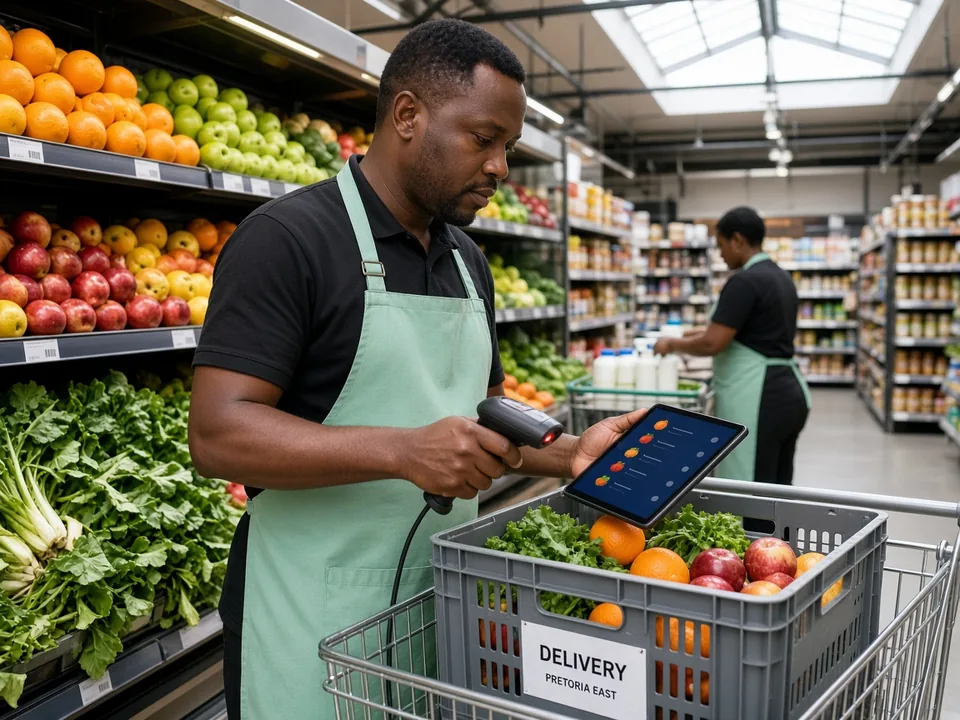
This one surprises people. Weight-based products, out-of-stock handling, substitutions, and partial fulfilment take real engineering work. Grocery stock behaves nothing like a normal e-commerce catalogue.
Delivery logistics
Delivery zones, time slots, route planning, and proof of delivery all sit on top of the base app.
Integrations
Payment gateways, maps, SMS, POS, and ERP systems each add setup time and ongoing cost.
Scale
1,000 orders a day and one hundred thousand orders a day are two completely different engineering problems. Servers, databases, and even your support team need to grow with volume.
In my experience, clients almost never expect inventory sync to be this heavy a piece of work. They expect the app screens to be the hard part. It's usually the opposite.
Grocery App Features and What They Cost to Build
Not every feature carries the same weight.
| Feature | Why it matters | Cost impact |
|---|---|---|
| Product search | Helps shoppers find items fast | Medium |
| Live inventory | Stops orders for items that are out of stock | High |
| Smart substitutions | Handles unavailable products gracefully | High |
| Delivery tracking | Shows order progress in real time | High |
| Vendor management | Runs marketplace operations | High |
| Route optimisation | Improves delivery speed and cost | High |
MVP Grocery Delivery App Cost in South Africa
If your budget sits closer to the ZAR50,000 to ZAR250,000 range, you are likely building an MVP, and that is not a bad thing.
A grocery MVP should include registration, a product catalogue, search, cart, checkout, payment, order tracking, and a basic admin panel.
Leave out AI recommendations, advanced route planning, loyalty systems, and predictive stock tools for later.
One mistake I see again and again. Founders treat the MVP like a smaller copy of their dream app instead of a real test. An MVP exists to prove people will actually order groceries through your app. It is not the place to prove every feature idea you have ever had.
If you want to test demand before spending your full budget, looking into MVP mobile app development in South Africa is a smart first step for early-stage grocery founders.
Understanding grocery delivery app development cost in South Africa also means understanding who builds it and at what rate.
How Much Do Grocery App Developers Cost in South Africa?
Grocery app developer rates vary by experience, tech stack, integrations, backend complexity, and project requirements.
| Developer level | Approximate hourly rate |
|---|---|
| Junior | ZAR150 to ZAR450 |
| Mid-level | ZAR350 to ZAR750 |
| Senior | ZAR600 to ZAR1,200 |
| Specialist or agency | ZAR700 to ZAR1,800+ |
Grocery App Development Cost by Project Stage
Development cost changes at each stage, from discovery and UI UX design to coding, integrations, QA testing, deployment, and maintenance.
| Stage | Explanation | Cost Impact |
|---|---|---|
| Discovery | Defines user flows, grocery catalogue, delivery zones, inventory rules, payment needs, and business requirements before development starts. | 5% to 10% |
| UI and UX | Designs shopping, search, cart, checkout, order tracking, and substitution flows for a simple South African grocery experience. | 10% to 15% |
| MVP Development | Builds customer registration, product catalog, shopping cart, checkout, order management, notifications, and basic delivery tracking. | 40% to 60% |
| Backend and APIs | Handles inventory management, stock levels, orders, user data, authentication, APIs, database logic, and real-time order status. | 20% to 30% |
| Integrations | Connects payment gateways, maps, GPS tracking, POS systems, ERP platforms, SMS services, and inventory synchronisation. | 5% to 15% |
| QA Testing | Tests checkout, payments, inventory updates, push notifications, APIs, device compatibility, order tracking, and delivery workflows. | 10% to 15% |
| Deployment | Covers production configuration, app signing, store submission, backend deployment, security settings, analytics, and release preparation. | 3% to 5% |
| Post Launch | Includes bug fixes, security patches, OS updates, API changes, performance monitoring, database maintenance, and feature improvements. | 15% to 20% |
Grocery apps need more testing than most people expect. Payments, inventory, and delivery tracking all need to work together without breaking, which is exactly why mobile app testing in South Africa is a bigger part of the budget than founders usually plan for.
South African Integrations That Affect Grocery App Cost
Building for South Africa means thinking about the local ecosystem, not copying a generic template.
Payments. Local card processing and instant payment options matter here. The South African Reserve Bank describes PayShap as a real-time retail payment service built for safe, affordable, and interoperable transactions between banks.
Maps and location. Delivery addresses, geocoding, and route planning all depend on accurate map data for South African streets and townships.
SMS and WhatsApp. Used heavily for order confirmations and one-time passwords across South Africa.
POS and ERP integration. Big retailers already run point-of-sale and inventory systems. Connecting a new app to these takes real integration work.
Accounting systems. For reconciliation, tax, and reporting.
Each of these adds setup time, and most of them carry small ongoing fees too.
Hidden Costs of Running a Grocery Delivery App in South Africa
This part gets skipped in most articles, and it shouldn't.
| Ongoing Expense | What It Covers |
|---|---|
| Cloud Hosting | Runs your backend, database, APIs, inventory, orders, and customer data securely. |
| Maps | Covers GPS location, delivery zones, route data, distance checks, and real-time tracking. |
| SMS | Sends OTPs, order confirmations, delivery alerts, and status updates to customers. |
| Payment Processing | Covers transaction fees for card payments, EFTs, refunds, and digital checkout. |
| App Store Fees | Covers costs linked to publishing, distributing, and maintaining your mobile app. |
| Maintenance | Handles bug fixes, OS updates, API changes, performance issues, and feature improvements. |
| Security | Protects customer accounts, payment data, APIs, databases, and personal information. |
| Customer Support | Covers help with orders, refunds, payment failures, substitutions, and delivery issues. |
| Marketing | Covers customer acquisition through paid ads, promotions, referral campaigns, and retention efforts. |
South African Compliance Requirements That Affect Grocery App Cost
Compliance is not exciting. It is necessary.
POPIA. Governs how you collect, store, and use customer personal information. This affects how your database and login system get designed from day one. The Information Regulator publishes official guidance, and the government sets out the Protection of Personal Information Act itself.
Consumer Protection Act. The South African government states this act sets standards for consumer protection and consumer information and addresses unfair marketing and business practices.
Electronic Communications and Transactions Act. According to the South African government, this legislation governs electronic communications and transactions across the country.
Payment security. Your app should never store raw card details directly. Payment gateways handle that layer for a reason.
None of this is legal advice. Speak to a lawyer for your specific setup. But your developer needs to know these rules exist before writing a single line of code, because retrofitting compliance later is expensive and painful.
What Technology Stack Should a Grocery App Use?
The right tech stack balances development cost, app performance, scalability, real-time inventory, APIs, security, and future growth.
| Layer | Recommended Options | Cost Impact |
|---|---|---|
| Mobile | Flutter or React Native | Low to medium |
| iOS | Swift for native builds | Medium to high |
| Android | Kotlin | Medium to high |
| Backend | Node.js, Python, or Java | Medium |
| Database | PostgreSQL, MySQL, or MongoDB | Low to medium |
| Cloud | AWS, Azure, or Google Cloud | Medium to high |
| Maps | Google Maps Platform | Medium |
| Notifications | Firebase | Low |
If you are comparing one codebase against two native apps, this Flutter app development cost guide is a useful companion.
How AI Changes Grocery App Development Cost?
AI is not something every grocery app needs on day one. Let's be honest about that instead of chasing a buzzword.
AI can help with product recommendations, demand forecasting, smart substitutions, delivery predictions, and fraud detection.
But adding AI early usually raises your upfront cost without proving it will actually help your specific customers order more. Automation is not always the same thing as AI either. A simple rule-based reorder reminder can work just as well as a machine learning model, for a fraction of the price.
Add AI once your ordering data is clean and reliable, not before. If you do want to price that later phase, this AI development cost breakdown in South Africa is worth a look.
How to Reduce Grocery App Development Cost Without Cutting Corners?
You can control your budget without building something weak. Here is how.
- Start with one delivery zone. Test your grocery delivery model in one area before paying for citywide logistics, route optimisation, and fleet management.
- Build for one platform first. If your early customers mainly use Android, start with Android before investing in iOS, cross-platform testing, and two app release cycles.
- Keep the MVP focused. Your MVP should handle product search, shopping cart, checkout, payments, inventory, order tracking, and basic notifications without unnecessary extras.
- Avoid too many third-party integrations. Every API adds development and maintenance work, so launch with essential payment, maps, SMS, POS, or ERP integrations only.
- Choose cross-platform where it makes sense. Flutter or React Native can reduce duplicated mobile development when your grocery app does not need deep native features.
- Build a reusable backend. A scalable backend with reusable APIs, database structures, authentication, and order management can prevent an expensive rebuild as orders grow.
- Leave AI for when you have real data. Do not rush into demand forecasting or product recommendations before you have clean order history, inventory data, and customer behaviour.
- Test real ordering workflows early. Watch real users search products, handle out-of-stock items, choose substitutions, pay, and track deliveries before expanding the platform.
- Plan POS and ERP integrations early. Map your inventory synchronisation, SKU data, stock levels, order status, and POS or ERP workflows before development begins.
- Do not pay for features nobody needs. I've seen projects become far more expensive because teams built impressive features before proving customers actually wanted them. That one hurts later.
- Scale after the model proves itself. Once your orders, repeat purchases, delivery costs, and customer retention make sense, then invest in advanced analytics, automation, and multi-zone delivery.
Common Mistakes That Increase Grocery App Development Cost
This is where most guides stay too polite. Let's not.
Starting development without a clear scope is mistake number one. Vague requirements lead to constant rework, and rework is the most expensive thing in software.
Treating a grocery app like a normal shopping app is mistake number two. Inventory, substitutions, and delivery timing make grocery genuinely harder than selling shoes online.
Adding AI before fixing the basic ordering flow. Ignoring POS or ERP connections until late in the project. Building only the customer app and forgetting the driver and vendor side. Underestimating how much testing a live grocery platform actually needs. Ignoring what happens during peak order times, like weekends or month end.
Choosing a development partner based only on hourly rate is probably the most expensive mistake of all.
In my experience, the expensive mistake is rarely one extra feature request. It is usually a small decision made too early that becomes painful and costly to undo months later.
How Much Would an App Like Checkers Sixty60 Cost to Build?
People ask this a lot, and it deserves an honest answer.
The exact internal development cost behind a platform like Checkers Sixty60 is not public information. Any number floating around online is a guess, not a fact.
What we can say is what a similar platform would realistically need. A customer app, a large product catalogue, live inventory across many stores, a full delivery network, store operations tools, payments, route planning, notifications, and an admin system built to handle scale.
A new platform with comparable functionality could reasonably move beyond the ZAR1,500,000 range, depending on store integrations, delivery infrastructure, inventory architecture, scale, and operational requirements.
If your product also sits closer to restaurant or marketplace delivery, this food delivery app development cost guide can help you compare the two models.
How to Calculate Your Grocery App Development Budget?
Here is a simple formula that actually works.
Estimated hours multiplied by blended hourly rate, plus third party setup costs, plus a contingency buffer.
Say your project needs 1,200 hours and your blended rate is ZAR600 per hour.
1,200 multiplied by ZAR600 equals ZAR720,000.
Add setup costs for payments, maps, and SMS, then add a contingency of around fifteen percent for the unexpected, because something unexpected always shows up.
This is illustrative, not a fixed quote. Every project has its own shape. But for a broader sense of how software pricing works generally across the country, broader mobile app development costs in South Africa is worth a look too.
Final Thoughts
If you are building a basic grocery MVP, plan around the lower end of the range and grow from there.
If you need marketplace features, multiple user roles, and real logistics, expect a much larger investment.
And if you're dreaming of something closer to Checkers Sixty60 or Woolies Dash scale, your budget should come from real architecture planning, not a single number pulled from a blog post.
The grocery delivery app development cost in South Africa always comes down to the same few things. Scope, complexity, integrations, and the team you choose to build it with.
Get those right, and the rest of the budget starts to make sense.
Ready to scope the build? Explore grocery delivery app development services in South Africa.
Frequently Asked Questions
How much does it cost to build a grocery delivery app in South Africa?
It typically ranges from ZAR50,000 for a simple MVP to over ZAR1,500,000 for an advanced multi-vendor platform, depending on features and scale.
What is the minimum budget for a grocery delivery app MVP?
A basic MVP with core ordering features can start around ZAR50,000, though ZAR100,000 to ZAR250,000 gives more room for a polished first version.
How long does it take to develop a grocery delivery app?
A simple MVP can take 6 to 10 weeks. A full marketplace platform can take 6 to 14 months depending on complexity.
How much does a multi-vendor grocery app cost?
Multi-vendor marketplaces usually fall between ZAR600,000 and ZAR1,000,000 because of vendor management and commission systems.
Is Flutter cheaper than native app development?
Usually yes, since one codebase covers both Android and iOS, saving development hours compared to building two separate native apps.
What affects grocery app development cost the most?
Inventory complexity, number of user roles, delivery logistics, and third-party integrations tend to raise cost the fastest.
How much does it cost to maintain a grocery delivery app?
Ongoing maintenance, hosting, and support typically cost between 15 and 20% of the original development cost each year.