You have an idea. Maybe it hit you at 2 am while you were scrolling through Spotify, wondering why nobody built something like this for local artists yet.
Then you asked one simple question. How much will it cost?
And that is where things get messy. One agency quotes you R80,000. Another one says R900,000. You are left more confused than before you started asking.
This guide is here to fix that. We will walk through real numbers, real features, and the honest reasons why the music streaming app development cost in South Africa moves around so much. By the end, you will have a number in your head that actually makes sense.
What Is the Actual Meaning of a Music Streaming App, and How Can It Benefit You?
A music streaming app is a digital platform that lets users discover, play, save, and manage music online through internet-connected devices without downloading entire audio files.
According to Mobility Foresights, South Africa's music streaming market is projected to grow from USD 1.25 billion in 2025 to USD 4.96 billion by 2031, with a CAGR of 25.5% during 2025–2031.
Benefits of a Music Streaming App
- Build recurring revenue: Subscription plans and premium memberships can create predictable revenue from loyal listeners.
- Reach more listeners: Mobile streaming removes location barriers, helping artists and businesses reach audiences across South Africa and beyond.
- Support personalised experiences: Playlists, recommendations, listening history, and music discovery can keep users engaged for longer.
- Create multiple revenue streams: Combine subscriptions, advertising, sponsored playlists, artist promotions, and premium content.
- Build a scalable music business: Cloud streaming, APIs, analytics, and content management make it easier to expand as your listener base grows.
A specialist music streaming app development company in South Africa can help you decide which of these belong in version one.
How Much Does It Cost to Develop a Music Streaming App in South Africa?
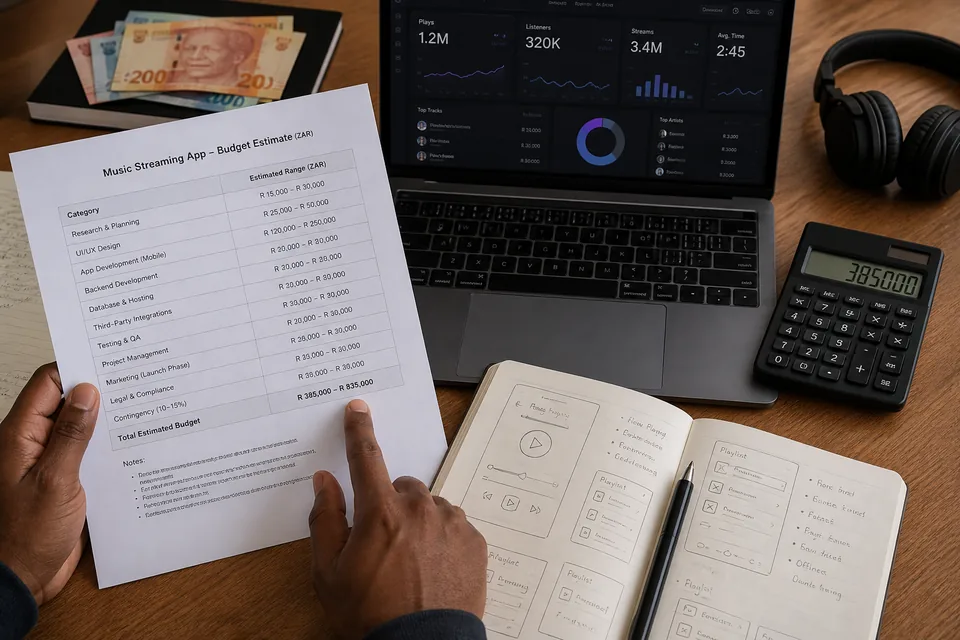
The music streaming mobile app development cost in South Africa ranges from ZAR 50,000 to ZAR 1,500,000+, depending on features, platforms, and streaming infrastructure.
| App Type | Estimated Cost (ZAR) | Estimated Timeline |
|---|---|---|
| Basic MVP | R50,000 to R250,000 | 2 to 4 months |
| Standard Streaming App | R250,000 to R600,000 | 4 to 7 months |
| Advanced Platform | R600,000 to R1,100,000 | 7 to 10 months |
| Enterprise-Level Platform | R1,100,000 to R1,500,000+ | 10 months and up |
Music Streaming App Features and Their Development Cost
Every feature adds its own price tag. Here is a rough feature-by-feature breakdown.
| Feature | Complexity | What it covers |
|---|---|---|
| User registration | Low | Lets listeners create accounts, manage profiles, and keep their preferences saved. |
| Music search | Medium | Helps users quickly find songs, artists, albums, and playlists they want to hear. |
| Audio player | Medium | Handles playback with controls for play, pause, skip, volume, and track progress. |
| Playlist management | Medium | Lets users create, edit, save, and organize playlists around their music tastes. |
| Subscription system | High | Manages paid plans, recurring billing, upgrades, cancellations, and premium access. |
| Offline listening | High | Lets users download selected tracks and listen without an active internet connection. |
| AI recommendations | Advanced | Studies listening habits to suggest songs, artists, and playlists users may enjoy. |
| Admin dashboard | Medium | Gives admins one place to manage users, music, subscriptions, reports, and content. |
Take the audio player row as an example. That single feature quietly leans on streaming architecture, authentication, media storage, APIs, player SDKs, background playback, caching, download logic, and device compatibility. None of that work is isolated, and most of it gets shared across other features too.
Premium Features and Their Impact on Music App Development Pricing
This is where the price really starts climbing.
AI Recommendations and Personalised Discovery
AI recommendations, personalised playlists, and smart discovery need user behaviour data, recommendation logic, analytics, and scalable cloud infrastructure. Building them too early can waste budget when listening data is limited.
Offline Listening and Advanced Streaming
Offline downloads, multiple audio quality levels, smart caching, and multi-region streaming add storage, CDN, bandwidth, encryption, and media delivery complexity. These costs grow as your audience grows.
Social, Artist and Premium Features
Social listening, live audio rooms, artist dashboards, content moderation, music uploads, and family subscriptions require deeper backend workflows. They can add real value, but only when your core product is ready.
What Factors Affect Music Streaming App Development Cost in South Africa?
Several decisions can quietly change the budget. A streaming app may look simple on the surface, but backend architecture, media delivery, licensing, and scalability can quickly add complexity.
Number of Platforms
Building for Android only keeps the initial scope smaller. Supporting iOS and Android means more testing, device compatibility work, native integrations, and release management.
| Platform Scope | Approximate Cost Impact |
|---|---|
| Android only | R50,000 to R250,000 |
| iOS only | R50,000 to R250,000 |
| iOS and Android | R100,000 to R500,000+ |
| Cross-platform | R70,000 to R350,000+ |
App Complexity and Features
A basic music player is very different from a platform with subscriptions, offline playback, AI recommendations, lyrics, analytics, and personalised discovery.
Cost: R50,000 to R1,500,000+
Streaming Architecture
Audio streaming needs CDN delivery, cloud storage, caching, transcoding, bandwidth management, and reliable playback. More users mean more infrastructure planning and monitoring.
Cost: R40,000 to R220,000+ initially, excluding ongoing usage.
Backend and API Complexity
Your backend handles accounts, music catalogs, playlists, subscriptions, analytics, APIs, and user data. A scalable architecture becomes increasingly important as listening activity grows.
Cost: R80,000 to R320,000+
Music Licensing and Compliance
Licensing can involve publishing rights, master rights, royalties, and territory restrictions. POPIA compliance and secure payment processing can also affect architecture and development effort.
Cost: Highly variable. Licensing and royalties should be budgeted separately.
Third-Party Integrations and Scalability
Payment gateways, analytics tools, notifications, cloud services, and external APIs add development and testing work. Designing for high traffic also increases infrastructure requirements.
Cost: R30,000 to R150,000+, depending on integrations and expected scale.
Music Streaming App Security and POPIA Requirements
A music streaming app collects more personal data than people usually realise.
Names, email addresses, payment-related information, listening behaviour, preferences, device information, and sometimes location-related data all pass through your systems at some point.
Under South Africa's data protection law, this data needs to be handled responsibly. You do not need to turn your app into a legal document, but you do need proper consent flows, secure data storage, and a clear idea of what information you are collecting and why. The Information Regulator of South Africa publishes official POPIA guidance.
Music Licensing and Royalties Can Change Your Real Budget
Most cost articles skip this part completely. That is a mistake, and honestly it bothers me a little.
Building a music streaming app is not only a software project. It is also a music rights project.
You need to think about music licensing, master rights, publishing rights, performance rights, mechanical rights, royalty payments, artist agreements, music catalogue management, territory restrictions, and copyright compliance.
Software development cost and music licensing cost sit in two completely separate buckets. Confusing the two is one of the fastest ways to blow your budget without even realising it.
In South Africa, music streaming can involve several rights and licensing relationships. Organisations such as SAMRO and CAPASSO are relevant to different rights and royalty areas, while RiSA represents interests within the recorded music industry.
A streaming business should confirm the specific rights it needs before launching its catalog. These organisations exist for a reason, and ignoring them early in your planning almost always causes delays later.
Technology Stack Needed to Develop a Music Streaming App and Its Cost
The right technology stack keeps your app fast, stable, and ready to grow.
| Layer | Technologies | Purpose | Rough Cost Weight (ZAR) |
|---|---|---|---|
| Mobile | Flutter, React Native, Swift, Kotlin | Building the iOS and Android applications | R40,000 to R250,000+ |
| Frontend | React | Web-based dashboards and player interfaces | R15,000 to R80,000 |
| Backend | Node.js, Python | APIs and business logic | R60,000 to R280,000+ |
| Database | PostgreSQL, MongoDB | Storing user and catalog data | R15,000 to R60,000 |
| Cloud | AWS, Azure, Google Cloud | Hosting and infrastructure | R10,000 to R100,000+ setup, then ongoing monthly usage |
| Storage | Cloud object storage | Holding audio files and media assets | R5,000 to R30,000 setup, then ongoing monthly usage |
| CDN | Amazon CloudFront or an equivalent content delivery network | Delivering audio quickly to listeners worldwide | R5,000 to R25,000 setup, then ongoing monthly usage |
| Analytics | Firebase and custom analytics tools | Tracking user behavior and app performance | R10,000 to R40,000 |
| Payments | Local and international payment gateways | Handling subscriptions and billing | R15,000 to R50,000 |
| DevOps | Docker, CI/CD pipelines, monitoring tools | Deployment, updates, and uptime monitoring | R10,000 to R40,000 |
Cost to Build a Music Streaming App by Development Team
Here is a question I get asked constantly. Why did three developers give me three completely different quotes for what feels like the same app?
The answer usually comes down to who is actually doing the work.
| Development Option | Typical Cost Position | Best For |
|---|---|---|
| Freelancer | Lower | Small MVPs and tight budgets |
| Local development team | Medium | Startups and growing businesses |
| Specialist agency | Medium to high | Complex platforms with real scale |
| In-house team | High ongoing cost | Long-term product development |
Hidden Costs of Running a Music Streaming App
The development invoice is only the beginning. Once real listeners arrive, infrastructure, licensing, and maintenance quietly become recurring expenses.
- Cloud hosting and storage: AWS, Azure, or Google Cloud costs rise with audio storage, users, backups, and server demand.
- Bandwidth and CDN: Every stream consumes bandwidth, while CDN delivery helps serve tracks faster as listener numbers grow.
- Audio processing: Transcoding, compression, multiple quality levels, and media processing add recurring infrastructure costs.
- Licensing and royalties: Music rights, royalty payments, and catalogue agreements can become major operating expenses as usage grows.
- Maintenance and support: Your software maintenance cost covers bug fixes, security patches, monitoring, updates, and ongoing technical support.
- Scaling and third-party tools: Analytics, payment APIs, notifications, monitoring, and higher traffic can push monthly costs up quickly.
How to Recover Music Streaming App Development Costs Through Monetisation?
Let us talk business for a moment.
- Subscription plans
- Freemium model with ads
- Advertising revenue
- Pay per download
- Artist promotion packages
- Premium content
- Family subscription plans
- Business subscriptions
- Sponsored playlists
A freemium model tends to work well for apps trying to build a user base fast. Subscription-only models often suit platforms that already have a loyal, paying audience from day one. There is no single right answer here; it depends on your market and your patience.
A radio and curated streamers model can work well when your platform focuses on programmed stations, genre-based channels, or personalised radio rather than a huge on-demand catalogue. Pandora and LiveOne are useful examples of this approach.
How Much Does It Cost to Build an App Like Spotify?
This question comes up a lot, so let us be honest about it.
Spotify-level functionality involves a huge content catalogue, complex recommendation systems, global licensing deals, scalable infrastructure, multiple subscription tiers, deep personalisation, cross-device sync, advanced analytics, and worldwide content delivery.
That is not a small project. That is closer to R1,500,000 and beyond, sometimes far beyond, depending on scale.
If you are building an on-demand or general catalogue platform, the infrastructure becomes considerably more demanding because users expect instant access to a large music library. Spotify, Apple Music, and YouTube Music all operate at this broader catalogue scale.
In my experience, one of the costliest mistakes founders make is trying to copy a mature streaming platform before proving people even want their product. Spotify took years and enormous funding to become Spotify. Your first version does not need to look like theirs. If your product also includes video, see our guide to OTT and video streaming app development cost in South Africa.
Common Music Streaming App Development Mistakes That Increase Costs
One pattern I keep noticing is a founder trying to launch with every feature they have ever seen on Spotify, instead of the two or three that actually matter to their first users.
It stretches the budget and pushes the launch date further away, without necessarily making the app better.
- Building too many features in version one.
- Ignoring licensing until development already begins.
- Choosing technology based only on price.
- Underestimating streaming infrastructure needs.
- Skipping performance testing.
- Ignoring bandwidth costs.
- Building AI recommendations too early.
- Failing to define the target audience.
- Not planning monetisation from the start.
- Using poor UX.
- Not designing for scalability.
Let me ask you something honestly.
Do you really need offline downloads in your first release?
Do you need AI recommendations before you even have enough listening data to train them properly?
Do you need both iOS and Android on day one, or could you test with one first?
Answering these questions early saves real money later.
How to Reduce Music Streaming App Development Cost Without Cutting Quality?
Good news. You can save money without building something cheap or broken.
- Start With a Focused MVP. Build core streaming, search, playlists, and subscriptions first. Add advanced features after real users show you what matters. See our guide to MVP mobile app development in South Africa.
- Choose Cross-Platform Development Wisely. Flutter or React Native can reduce duplicate development work across iOS and Android while keeping the user experience consistent.
- Keep UI and UX Practical. A clean interface does not need endless design revisions. Control your UI/UX design cost by focusing on discovery, playback, and simple navigation.
- Use Managed Cloud Services. AWS, Google Cloud, and similar services can handle storage, CDN delivery, and scaling without forcing you to build everything from scratch.
- Delay Expensive Features. Do not rush into AI recommendations, offline downloads, or complex analytics. Build modularly, measure user behaviour, then spend where it counts.
Choosing a Music Streaming App Development Company in South Africa
If you decide to hire a team, choose carefully. This decision affects everything that follows, far more than most founders expect going in.
- Check streaming experience: Start by asking about their streaming experience specifically, not just general app work.
- Review technical expertise: Ask about backend development, cloud architecture, security practices, and scalable streaming infrastructure.
- Check their portfolio: Ask to see real portfolio evidence, not just a list of claims on their website.
- Ask about licensing: Do they ask about your music licensing plans before giving you a development quote?
- Discuss expected users: Do they ask how many users you expect in year one? This can affect backend architecture and infrastructure costs.
- Understand their testing process: Do they explain how they handle performance, security, device compatibility, and streaming quality testing?
- Ask about post-launch support: Find out whether they provide ongoing maintenance and support or simply hand over the app after launch.
- Watch for rushed quotes: If a music streaming app development company in South Africa skips straight to a price without understanding your project, treat it as a warning sign. A rushed quote often means a rushed understanding of your actual requirements.
How Much Should You Budget for a Music Streaming App?
If someone handed me a blank slate and asked me to plan a budget honestly, here is how I would think about it.
- Lean startup approach. A focused audience, basic streaming, search, playlists, subscriptions, a simple admin panel, and maybe just one platform to start. This sits closer to the R50,000 to R300,000 range.
- Growing platform approach. Better personalization, artist profiles, analytics, offline listening, more advanced subscriptions, and sturdier infrastructure. This usually lands somewhere between R400,000 and R900,000.
- Large-scale platform approach. AI recommendations, advanced analytics, a large catalog, multi-region infrastructure, high availability, and complex licensing arrangements. This is where you cross into R1,000,000 and often push past R1,500,000.
Would I recommend jumping straight to the large-scale option on day one? Almost never. Prove the idea first. Let real listeners tell you what to build next.
Conclusion
So where does that leave you?
The honest answer is that the music streaming app development cost in South Africa depends entirely on how big your ambition is right now. A lean MVP can start around R50,000. A platform built to rival the big names can climb well past R1,500,000.
Neither answer is wrong. What matters is picking the version that matches where your business actually stands today, not where you hope it will be in five years.
Start small if you need to. Listen to your first users. Grow the platform based on real behaviour, not guesses. That approach has saved more founders from wasted budgets than any feature list ever could.
Ready to scope the build? Explore music streaming app development services in South Africa.
FAQs
How much does it cost to build a music streaming app in South Africa?
Costs usually range from R50,000 for a basic MVP to R1,500,000 or more for a full-featured platform, depending on complexity, licensing, and infrastructure needs.
How much does it cost to build an app like Spotify?
Spotify-level features involve massive catalogues, global licensing, and heavy infrastructure. Realistic budgets here often exceed R1,500,000.
How long does it take to develop a music streaming app?
Most projects take anywhere from 2 months for a basic MVP to over 10 months for an advanced platform.
What features should a music streaming MVP include?
Login, a basic music library, search, a working player, and simple playlists are usually enough for a first version.
How much does it cost to maintain a music streaming app?
Maintenance costs vary based on infrastructure size, but plan for ongoing hosting, support, security patches, and licensing renewals every month.
Do music streaming apps require licensing?
Yes. Music licensing through bodies like SAMRO and CAPASSO is required for legal music distribution in South Africa.
What technology is used to build music streaming apps?
Common choices include Flutter or React Native for mobile, Node.js or Python for backend, and AWS or Google Cloud for infrastructure.
Can I build a music streaming app with Flutter?
Yes, Flutter is a popular choice for cross-platform music apps since it speeds up development for both iOS and Android.